

Magazine
Everything That Led to the Making of a Celery Bag
transcript House Tour | Adrian Appiolaza The Moschino creative director displays selections from his 4000-piece collection of post-1980s Japanese and French fashion in the Paris apartment he shares with his partner, Ryan Benacer. Hello, T Magazine …

transcript
House Tour | Adrian Appiolaza
The Moschino creative director displays selections from his 4000-piece collection of post-1980s Japanese and French fashion in the Paris apartment he shares with his partner, Ryan Benacer.
Hello, T Magazine. I’m Adrian, and welcome to my apartment in Paris. We’re going to show you a lot of archive pieces. We love collecting. Here we are in our living room, where we love to keep some of our latest arrivals. So, our friend here, Javier, he’s wearing Jean-Paul Gaultier, 1989 — “Le Cowboy Baroque.” Here we are in our office. This is actually a logistic room where the archive comes in and out. So, this is our bedroom, and here I am with Bianca. We both are wearing Martin Margiela duvet covers from 1999. So, here we are in our black room. I love this room because it has the spirit of cabinet de curiosités. And this is our closet. Here is where we keep most of the pieces we like to wear. So. this is our kitchen. We don’t cook too much here. There’s always religious iconography in my house, which is something that I have a passion for. Thank you, T Magazine, for the visit. I hope you enjoyed my apartment in Paris. And see you soon. Bye, bye!
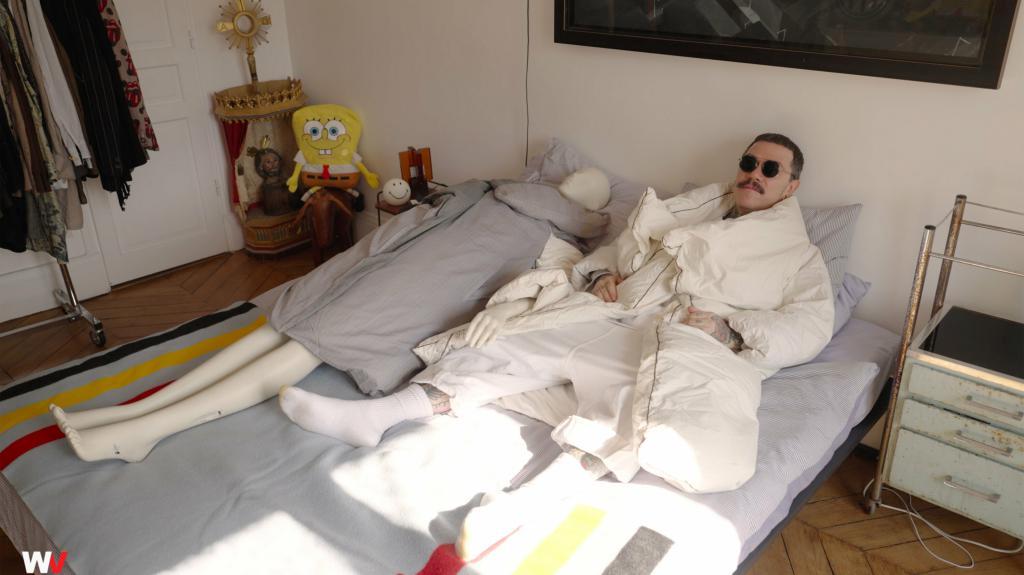
The Moschino creative director displays selections from his 4000-piece collection of post-1980s Japanese and French fashion in the Paris apartment he shares with his partner, Ryan Benacer.CreditCredit…Gautier Billotte
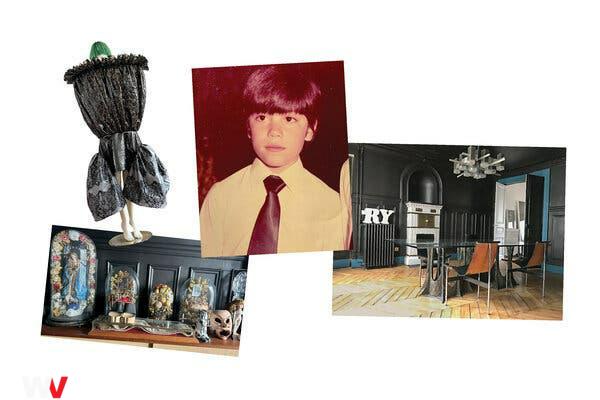
I was brought up in a religious family in Buenos Aires. Every Sunday, I’d go to church with my grandma. This picture (below center) was taken at my first communion, in 1982. I’d never worn a tie before; I think I had on velvet trousers. Even at age 10, I was opinionated about how my family dressed, saying things like, “Maybe you should wear that with a jacket.” I also paid attention to what the statues were wearing, the textures of their garments and the expressions on their faces. That’s where my fascination with religious iconography came from. In my apartment in Paris, I have a collection of pieces that belonged to churches (below bottom left). I found these [relics] in the basement of a little store in Puglia, Italy, and was like, “OK, this I need.” I like the mystery of things that have had a life before me.
Credit…Courtesy of Adrian Appiolaza
This is the dining room in my apartment (above right). The 1970s Brutalist table is by the American designer Paul Evans. The mirrored light on the ceiling is by [the Italian designer] Gaetano Sciolari, also from the 1970s. I found the letters “R” and “Y” at a flea market in Paris. They were part of a set that spelled “Harmony,” but that was too long — and my partner’s name is Ryan [Benacer, a stylist and fashion archivist]. In my living room, I have a collection of mannequins that I dress with the latest finds for our [clothing] archive. Ryan and I like to put out three to four at a time so that when we’re having breakfast, I can see, say, a Martin Margiela look next to me. This is a Comme des Garçons look (above top left) from spring 2023; I love how [the designer Rei Kawakubo] combines fashion and art without fear.
As a teenager, I was a goth. I loved the Cure, and then I became obsessed with [the Australian dark-wave band] Dead Can Dance (above right). When I first started thinking about a career, fashion felt odd for a guy, and I was still discovering my sexuality. I studied architecture at the University of Buenos Aires. When I turned 21, though, I went to London, where my passion for clothing really solidified. I worked as a bartender and saved money in a sock for four years, and eventually enrolled at Central Saint Martins. This is a look from my 2002 graduation collection (above center), which was inspired by traditional gaucho clothing (above left). My grandmother had a lot of ponchos that I was interested in; I tried to bring in as much craft as possible, to do it the way the Indigenous Argentines would have done. I won the prize that year for best ready-to-wear collection and was offered a place in the master’s program. But then Phoebe Philo, who’d just taken over at Chloé, called me to be her right hand for design, and I moved to Paris for the job.