
Fashion
Tom Cruise Understands Something Crucial About Stunts. (And Movies.)
His intense devotion to doing his own stunt work can seem pathological. But it’s part of a more charming devotion to moviegoing itself.
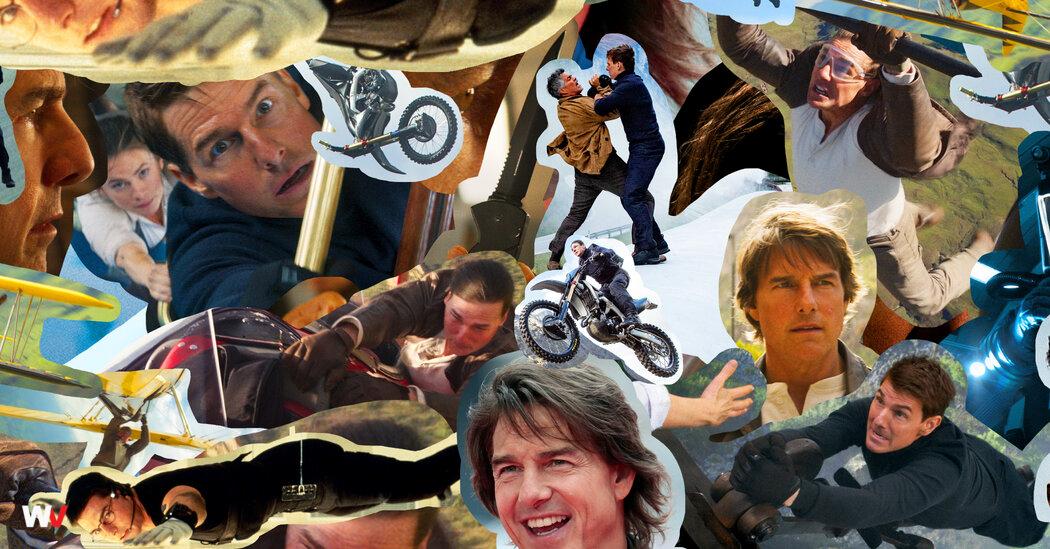
Every “Mission: Impossible” movie can be boiled down to a single, central image. Tom Cruise in glasses and a black vest, hanging by wires, inches above the floor. Tom Cruise dangling from a rocky cliff ledge. Tom Cruise sticking like a gecko to the glass panels of the Burj Khalifa. Tom Cruise in some kind of spacesuit, hurtling through the air toward the camera. Tom Cruise in midair again, arms stretched backward as a motorbike falls below him, making it look all the more as if he were flying. For the newest and purportedly last installment in the series, “The Final Reckoning,” the iconography has been perfected: We see Cruise dangling from a banana-yellow biplane as it hurtles through the sky. Oh, and the plane is upside down.
In the opening minutes of “The Final Reckoning,” all of the iconic images from previous films are repeated back to us, reminding us that what we are here for is to see Tom Cruise perform breathtaking stunts. Of course, if you were in the theater, then you would have been sold on this idea already. The film’s marketing has made the sight of the upside-down biplane so familiar that before the movie had even started, I overheard a couple in the seats behind me discussing how the stunt might have been done. (“Where are the wires, you think?”)
We’re compelled to know how these stunts were done for one very simple reason: We believe that Tom Cruise really is clutching the side of a skyscraper or an upside-down plane. This is because Cruise and many, many other people have worked hard to ensure our belief that Tom Cruise does his own stunts.
Some of this belief-bolstering work is technical and filmic: The cameras move close to Cruise and linger there, convincing us that it really is him doing the thing. But a monumental part of the effort has to do with Cruise himself, and his ability to persuade us that if we buy a ticket for his movie, we will see him create a harrowing spectacle. On one hand, we will be watching a movie about a fictional character named Ethan Hunt, whose mission seems impossible. On the other, we will be watching Tom Cruise, a movie star we have known for 40-plus years, doing the seemingly impossible.
This collapsing of character and star has become only more central to the films as the franchise goes on, sometimes sabotaging the movies’ impact, sometimes making them more interesting, sometimes both at the same time. For example, the antagonist in these final two installments is a runaway A.I. called the Entity. For a series that once had the great Philip Seymour Hoffman play a villain, evil software feels like a step down. But Ethan Hunt/Tom Cruise battling a faceless, ageless superintelligence that is able to fake practically anything? That is a rich text.