Magazine
Can a Finnish Sauna Improve Society?
ON A WARM September afternoon in subarctic Finland, the architect Laura Mattila kneels in the grass beside a sauna that she and Mikko Merz, her 49-year-old partner in life and work, built eight years ago in the factory town turned artists’ colony of …

ON A WARM September afternoon in subarctic Finland, the architect Laura Mattila kneels in the grass beside a sauna that she and Mikko Merz, her 49-year-old partner in life and work, built eight years ago in the factory town turned artists’ colony of Fiskars, an hour’s drive west from Helsinki. Mattila, 40, doesn’t mention the near-perfect symmetry of the building’s two 135-square-foot volumes (one a changing room, the other the sauna), separated by an open void that frames the forest; or the construction’s elegant lock joints, folded like knuckles over the corners of its solid timber walls. Instead, she wants to discuss how the building works: Thin layers of linen packed between logs provide insulation; the stove’s residual heat and air circulation below dry the sauna between uses; gaps around the windows and doorjambs allow the timber to contract over time as it loses moisture. “If you think of a Finnish farmhouse, this is essentially how you build it: a log frame, an oven for baking and, once you’ve lived there for a while, you make another log frame and fill the gap between,” Mattila says. The project’s client, a 54-year-old conductor and violinist named Jan Söderblom, recalls asking the architects for “a combination of timeless and archaic.” So they gave him something virtually indistinguishable from the barns and saunas that Finns have built in their hardscrabble homeland for centuries.
The Finnish sauna as we know it first emerged some 3,000 years ago in the icy transition between the Bronze and Iron Ages, though sweat bathing had been common to many cultures for millenniums before that. As farming became more difficult in the hills and forests of pine, spruce and birch that comprise modern-day Finland, some agrarian communities began using ax-hewn logs to erect threshing barns that they could deconstruct and move at will. By trapping smoke inside those structures to dry their barley and rye crops, they imbued the walls of pine, the most common Finnish timber, with radiant heat — the same method used today in the savusauna, or smoke sauna.
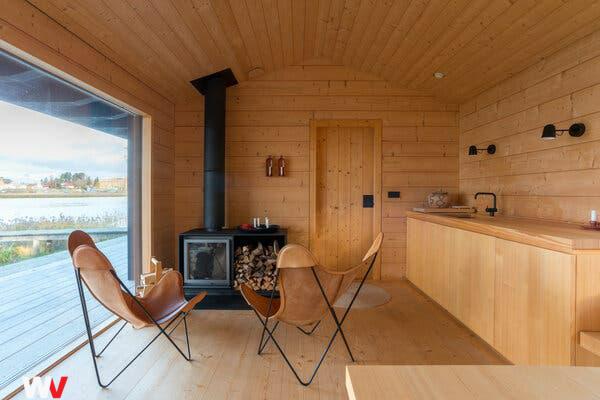
At OOPEAA’s sauna, completed in 2019 for the Aarne Ervi-designed Villa Koivikko outside Helsinki, a wood-burning stove helps keep a dressing and resting area warm.Credit…Luana Rigolli
Eventually, saunas became the locus of Finnish society. They were where women gave birth, where the sick sought treatment, where the dying received their last rites. Families cooked over saunas’ open stoves and preserved meat and fish in their dry, ambient heat. Saunas served as kitchens, clinics, temples and inns, open to destitute neighbors and unknown travelers seeking escape from the cold. Although popular through the Middle Ages, sweat bathing dissipated in the 16th century as plague, smallpox and syphilis epidemics ravaged Europe. But on the continent’s northern periphery — an impoverished backwater of Sweden until 1809 and then of the Russian Empire for more than a century after that — timber saunas continued to thrive, transforming into a pillar of domestic identity by the time Finland won independence in 1917. As the Norwegian American writer Mikkel Aaland notes in “Sweat,” his 1978 history of global sauna traditions, “No other country has attached so much national pride to their bath.”
Finland now has a social welfare system that rivals those of its Scandinavian neighbors, and about three million saunas for its population of 5.6 million people. In these spaces — from tiny lakeside cabins to semipublic spas in city centers — “it doesn’t matter how much money you have or what you do,” says Saija Silen, a 48-year-old curator at the Museum of Central Finland in the city of Jyväskylä. “The sauna is the foundation of Finnish equality.”