

Magazine
This Beloved Ginger Ale Is Made With a Dozen Ingredients
Plus: a California hot spring retreat, an exhibition of Dorothea Rockburne’s artwork and more recommendations from T Magazine.
Welcome to the T List, a newsletter from the editors of T Magazine. Each week, we share things we’re eating, wearing, listening to or coveting now. Sign up here to find us in your inbox every Wednesday, along with monthly travel and beauty guides, and the latest stories from our print issues.And you can always reach us at tmagazine@nytimes.com.
Stay Here
A New Guesthouse Filled With Danish Design in Todos Santos, Mexico
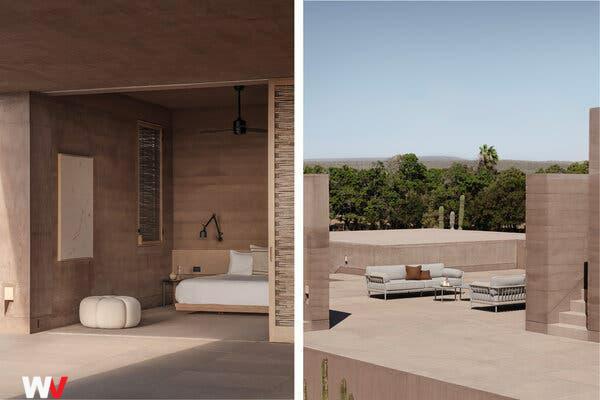
Left: the property’s primary bedroom outfitted with Vipp lighting and furniture. It features sliding window shutters woven from branches of the local Palo de Arco tree. Right: the roof terrace set with pieces from Vipp’s outdoor collection.Credit…Anders Hviid
By Natalia Rachlin
The Danish brand Vipp was founded in 1939 with a single design: a waste bin. In the decades since, its product line has expanded to include a full furniture range, lighting and home accessories. In 2014, Vipp opened its first guesthouse, a contemporary prefab cabin near Lake Immeln, in southern Sweden. It now runs nine vacation rentals in Europe and, as of today, is taking reservations for its first in North America, a five-bedroom home in Todos Santos on the Pacific Coast of Mexico’s Baja California peninsula. Sofie Christensen Egelund, the third generation co-owner of Vipp, was introduced to the region by the Mexico City-based architect Pablo Pérez Palacios, who’s behind the property’s design. The 3,800-square-foot home has a rooftop pool and open interiors that highlight natural materials: The walls are made of rammed earth, while window shutters are woven from branches of the local Palo de Arco tree. Furnishings include some of Vipp’s own pieces as well as the brand’s signature kitchen, a modular system with minimalist hardware. Pérez Palacios sees the final space as “an ongoing dialogue between Mexican and Danish design sensibilities.” From $2,500 a night, vipp.com.
Try This
Skin Care From a Japanese Sake Maker
By Mahira Rivers
Sake brewers in Japan are said to have especially smooth, baby-soft hands from years of dipping them into vats of fermented rice wine. This stems from the fact that sake lees, a byproduct of the sake making process, are full of amino acids and are believed to have moisturizing properties. These lees, also known as sake kasu, are a familiar ingredient in Japan and are repurposed into everything from marinades to fortifying sipping broths. This spirit of no waste, or mottainai in Japanese, is also behind a line of sake kasu beauty products created by Dassai, a premium sake brand from Yamaguchi, Japan, best known for its junmai daiginjo sake, which is made from Yamada Nishiki rice polished down to at least 50 percent of its original size. In 2020, the company launched Dassai Beauty, which now includes a moisturizing lotion, face mask and bar soap enriched with sake kasu. “To use our byproducts in this way helps to reinforce our brand’s commitment to sustainability,” says Kenzo Shimotori, president of Dassai USA. It’s also consistent with the brand’s effort to reach American consumers. Dassai recently inaugurated a 55,000-square-foot brewery and tasting room in Hyde Park, N.Y., where the skin care is available to purchase. From $5 for bar soap, dassai.com.
See This
The Italian Designer Repurposing Car Parts and Stone Slabs to Create Furniture

By Gisela Williams
The Italian designer Enrico Marone Cinzano took a circuitous route to his current occupation. He started his career working in finance, then in 2001 co-founded the fashion line Project Alabama. After experiencing a severe injury to his spine in 2007, he sold the company and traveled around the world to seek out healers and alternative medicine practitioners. During that time, Marone Cinzano says he learned how to cook, make candles and scents and grow medicinal plants. “That’s also when I started to make furniture,” he says. When he builds a collection, Marone Cinzano often begins with material that’s discarded or broken. He’s used parts of an old motorcycle and leftover stone fragments that he sourced from a mason in Jaipur, India. “I might choose a piece of white agate and from that make a lamp,” he says. In his first solo exhibition for Friedman Benda, which opened earlier this month at the gallery’s Chelsea location, Marone Cinzano is presenting a new series of flat-pack chairs made of stone offcuts and lamps created from car headlights and rose quartz. Marone Cinzano said the title of the show came from his interactions with the makers with whom he collaborated; every time one of them had a query about a design, he would respond with an answer inspired by the environment. One day, an artisan commented, “You really are obsessed by nature, aren’t you?” recalled Marone Cinzano. He replied, “Yes, I am.” “Obsessed by Nature” is on view through Dec. 14, friedmanbenda.com.