Magazine
No Shoes, No Phones Allowed at This Brooklyn Shop
Plus: Sardinian furniture, a Jordan Casteel exhibition and more recommendations from T Magazine.
Gift This
Bed Linens and Bath Towels in Shades of Moss and Butter Yellow
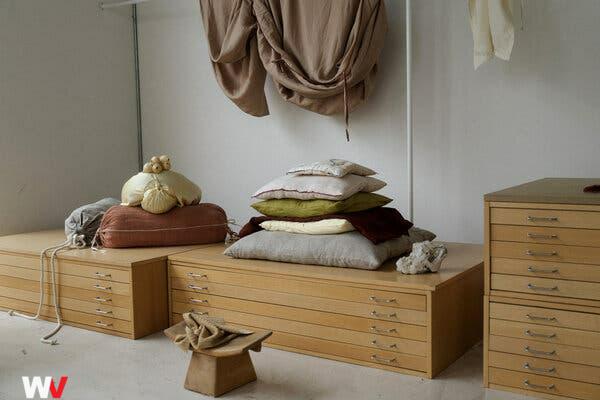
Baserange, the Copenhagen brand known for its understated clothes in nature-inspired colors, is launching its first collection of home goods including bed linens.Credit…Courtesy of Baserange
By Gage Daughdrill
Since its founding in 2012, the Copenhagen-based clothing brand Baserange has become a go-to for its bodywear and undergarments with minimalist silhouettes. Co-founders Blandine Legait and Marie-Louise Mogensen started it with the goal of creating pieces that would allow movement and provide comfort. Now, they’re expanding into homewares with a similar mission. The Baserange Home collection is launching with towels, tablecloths and bed linens in the brand’s signature earthy hues (including terra cotta, dusty pink and foggy gray), made with organic cotton and EcoVero viscose, a material composed of wood fibers harvested from forests that are certified sustainable by the Forest Stewardship Council. The designers intend the line to be adaptable: The Yoga Mat towel announces its multiple uses in its name, while Mogensen imagines “taking a home on the go” by bringing the striped Shell towel out of the bath and onto the beach or rolling it up to stuff in the oblong Shell pillowcase while traveling. The Baserange Home collection launches Sept. 18; from $40, baserange.com.
Go Here
Chowa Library Brings Japanese Design to Bushwick
By Devorah Lev-Tov
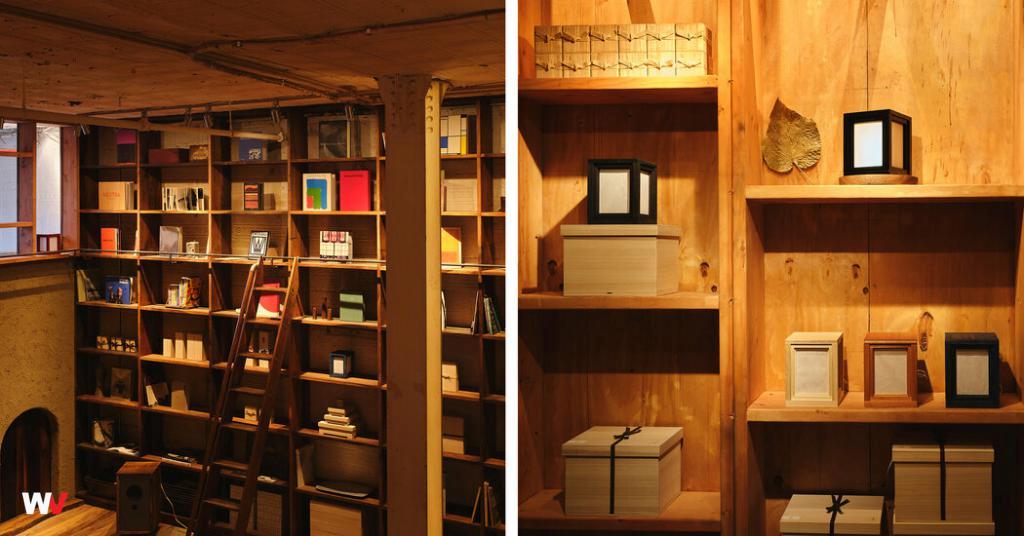
New Yorkers looking for a moment of calm can now find sanctuary in a former warehouse in Bushwick, Brooklyn. In the basement of the BogArt building, which otherwise houses artist studios and galleries, Chowa Library occupies a serene, lofted space. Kumbuk wood from Sri Lanka lines the floor, while some walls are made of mud mixed with sawdust to create texture. Although it’s called a library (and though there are some books to browse), it’s also a shop, a teahouse, a Japanese design showroom and a general relaxation area — no cellphones or shoes allowed. (Lockers are available upon entry.) The graphic designer Ray Suzuki, who was born in New York and raised in Tokyo, first started Chowa as a brand. He imported traditional kiri-bako, Japanese wooden boxes used in tea ceremonies, to the U.S. in 2023 and also created a lamp made from the box, all of which are sold at Chowa Library, which opened in July. Here, Suzuki hopes to share “the story of not just the box, but the culture surrounding it that’s unique to us.” On one wall is a small door, inspired by a teahouse entryway in Kyoto, that forces visitors to stoop down as they walk in, symbolizing that all are equal. Reservations are necessary, and 60 percent of each entrance fee is donated to the Association for the Promotion of Traditional Craft Industries in Japan. Entry from $25 for a 2.5-hour visit, chowalibrary.com.
See This
An Artist’s Abstract Exploration of the Body
By Laura Bannister

The Indianapolis-born artist Meeson Pae has become known for her lush oil paintings in which oozing fluids and roseate flesh merge with hard-edge machinery. At her debut solo show, “Permeate,” opening this month at Anat Ebgi gallery in Los Angeles, Pae’s wider oeuvre will be on view for the first time through an array of abstracted paintings, sculptures and videos. Her work is informed by the childhood loss of her younger brother to non-Hodgkin’s lymphoma, and by her desire to understand how our bodies function. She begins many of her pieces by iterating on basic shapes — such as spheres — using 3-D sculpting programs, which she likens to hand building with clay. “Confronting death at an early age and experiencing the fragility of the body, there was an early understanding of uncontrollable forces,” she says. “In the digital realm you can defy gravity, apply any lighting scenario and create impossible vantage points.” And though we might associate computer-generated riffing with smoothness and predictability, Pae insists it’s the opposite: “These built environments are processed through machines that have uncontrollable errors and glitches that leave markings, etching, and memory of process and time.”One such work is the sculpture “Accretion” (2024), in which two industrial steel poles are crowned with 3-D-printed resin mounds that might be testicles, breasts or organs. “The bulbous forms are meant to evoke something simultaneously organic and structural,” says Pae, “blurring the line between the body and the architecture that supports it.” “Permeate” will be on view Sept. 21 through Nov. 2 at Anat Ebgi, Los Angeles, anatebgi.com.