Magazine
A House That Memorializes a Vanished New York
In Lower Manhattan, the former residence of an artist couple remains unchanged years after their deaths.
IN OCTOBER 1976, the artists Geoffrey Hendricks and Brian Buczak met at a SoHo loft party. Hendricks, then 45, was associated with the Fluxus movement, a loose affiliation of 1960s conceptual artists, including Joseph Beuys, John Cage and Yoko Ono, who rejected traditional practices like abstract painting in favor of elaborate performances. Five years earlier, he’d co-starred in a notable one: In the summer of 1971, Hendricks and his wife of 10 years, the artist Nye Ffarrabas (then Bici Forbes), who were both gay, staged a piece called “Flux Divorce,” which involved taking a chain saw to their marriage bed and dividing the entryway to their home with barbed wire. (Their young children, Tyche and Bracken, weren’t around for the actual show; they only observed the cleanup afterward.) Buczak, a painter who was 23 years Hendricks’s junior, had recently relocated from Detroit, where he was raised. As luck would have it, Hendricks had been staying in a dilapidated townhouse in Hudson Square, then a manufacturing neighborhood on the west side of Lower Manhattan, which he’d eventually buy from his younger brother Jon, a Fluxus artist and archivist who lived next door. Buczak moved in a few months later.
The pair began renovations, but they had an unusual goal. Instead of modernizing the interiors, they decided that their home and studio — and the eventual headquarters for their publishing project, Money for Food Press — should look and feel like they imagined it would have in the 1820s, around when it was built. They repurposed discarded crown molding and fireplace mantels and acquired only chairs and silverware that seemed to fit the period; one winter, they made breakfast in the fireplace using an 18th-century waffle iron. It was Buczak’s idea to paint the walls of the children’s room blue and stencil the wooden floors with a floral motif in the style of one of his favorite paintings by the early 19th-century portraitist Jacob Maentel. In turn, the house and its objects — an old kettle, some cups — started creeping into Buczak’s own canvases.
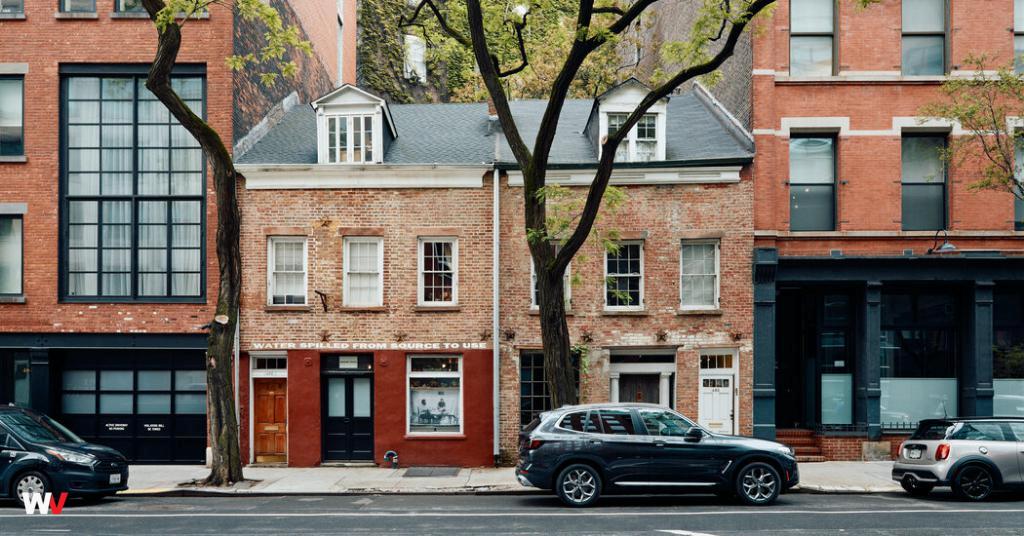
Today, even from the outside, the Federal-style building on Greenwich Street stands in striking contrast to the area’s luxury condos and wellness studios. Running the length of the facade is a 1984 text painting by Lawrence Weiner, a conceptual artist known for his typographical works, that reads “Water Spilled From Source to Use.” (In 1994, Weiner spoke to The Times about the mural: “Think of it as the water carried from wells,” he said. “Inevitably, on the way to being used, some of the water spills. It can be corrosive, for instance making something rust. Or it can make something grow.”) Both Buczak and Hendricks are now gone — Buczak died of complications from AIDS in 1987, Hendricks of cancer and congestive heart failure in 2018 — but, inside the house, the life they built together has been preserved as a kind of monument to a lost era of New York that might otherwise be forgotten.