Magazine
The Life-Affirming Properties of Sichuan Peppers
IT BEGINS WITH a hum. More precisely, you find yourself humming, only not of your own volition or making any sound. At first it’s faint, little micro-oscillations along the edges of the tongue, as if your mouth were a rung bell. Then, depending on …
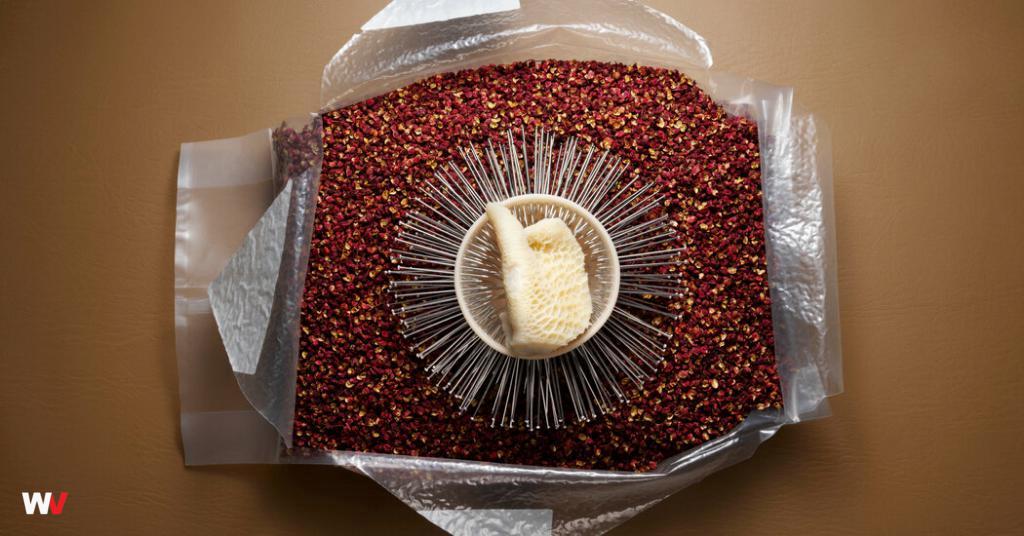
IT BEGINS WITH a hum. More precisely, you find yourself humming, only not of your own volition or making any sound. At first it’s faint, little micro-oscillations along the edges of the tongue, as if your mouth were a rung bell. Then, depending on the purity of what you’ve eaten and how much, it builds. People often describe the experience as numbing, but numbness is the loss of sensation, and this is the opposite: You are suddenly aware of your tongue’s every pore, of this strange landscape that is the tongue, an entire world within you. If you have eaten enough, you feel your lips balloon, except they don’t; nothing is happening that would be visible to the outside eye. If you speak, you’ll lisp. It’s as if you were being kissed by a horde of tiny bees.
Such is the effect of ingesting liberal amounts of hydroxy-alpha sanshool, an alkylamide that, instead of binding to taste receptors — as do compounds that trigger the reactions we identify as sour, salty, bitter and sweet — activates nerves primed to detect physical touch. Hydroxy-alpha sanshool abounds in plants of the genus Zanthoxylum, most famously those indigenous to China whose fruits are known in Mandarin as hua jiao and in English as Sichuan pepper. Zanthoxylum species with differing concentrations of the alkylamide grow around the world. In Japan, Korea, Nepal and parts of Laos, Thailand, India and Indonesia, their dried husks may be used to give a dish fragrance and floral, woodsy or sunny-sour undertones, along with a gentle twinge. But only in the southwestern Chinese provinces of Sichuan, Yunnan and Guizhou are the plants exploited to their maximum potential and essential to the cuisine. (So distinctive and singular is the buzz of Sichuan food that the wholly unrelated but similarly stimulating South American herb jambu has been called Sichuan buttons.)
Hua jiao is still something of a novelty in the West, its pleasures disorienting. As an ingredient, it has no real precedent in Western cooking. (Cloves, a key ingredient in many versions of chai and the perplexingly ubiquitous blend known as pumpkin spice, have the capacity to numb, but only in overwhelming, bitter quantities.) In 2020, Yao Zhao, a clean-energy consultant at the World Bank in Washington, D.C., and a native of Chongqing, a Chinese city that until 1997 was part of Sichuan, started selling Sichuan pepper oils through 50Hertz Tingly Foods, a company he co-founded with Lois Goh. He quickly realized that his biggest marketing challenge was explaining the tingle, or “ma” in Chinese. “If you’re not used to it, you might think it’s an allergy,” he says. The chef Simone Tong, who was born in Chengdu, Sichuan’s capital, ran the acclaimed Little Tong Noodle Shop in New York from 2017 to 2020, where diners sometimes expressed concern that they had food poisoning. “ ‘Is this magic mushrooms?’ ” she remembers one asking. “They couldn’t feel their tongues.” (She now owns Zoé Tong in Austin, Texas, with her husband and fellow chef, Matthew Hyland.) Travis Post, the chef of Plenty of Clouds in Seattle, which opened in 2018 featuring food from Sichuan and Yunnan, once had a panicked guest call the health department.
The problem isn’t lack of familiarity with Chinese food, which in the United States has attracted non-Chinese diners since the 1850s, when California Gold Rush miners in San Francisco bought cheap meal tickets at sprawling Chinese eating houses that could seat hundreds at once, as the historian Haiming Liu recounts in “From Canton Restaurant to Panda Express” (2015). Almost all early Chinese immigrants to the United States had roots in the southeastern coastal province of Guangdong — whose capital’s name was Anglicized as Canton — and so for decades what most Americans knew as Chinese food was Cantonese, a cuisine that prizes subtlety over sensation. Immigration reform and the abolition of country of origin quotas in 1965 brought new arrivals from other regions of China with their own culinary traditions.
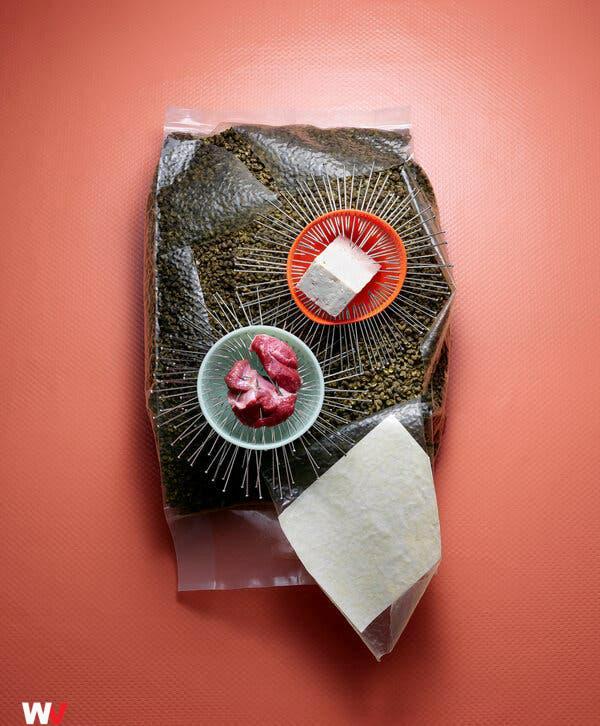
Firm tofu and raw beef atop an open bag of green Sichuan pepper.Credit…Photograph by Anthony Cotsifas. Set design by Martin Bourne. Food styling by Suea
But as Sichuan restaurants opened in major American cities, chefs had to contend with both wary Western palates and a government ban instituted in 1968 on importing hua jiao, which was suspected of harboring a disease fatal to domestic citrus crops. Until the early 2000s, the ban was hardly enforced, but the food writer Denise Landis reported a shortage of the spice in 2004 in The New York Times; U.S. Department of Agriculture inspectors had been confiscating stocks from grocery shelves, causing some Chinese shop owners to keep supplies hidden under the counter or to limit sales to Chinese-speaking customers. Even after the ban was lifted in 2005, restrictions remained: Before the spice could cross the border, it had to be blitzed at 140 degrees Fahrenheit to kill off bacteria, which sapped some of its scent and power. Much of the Sichuan pepper available in the United States in those years was old and low-grade, in any case, and “contributed nothing but gritty bitterness,” says Taylor Holliday, who founded the Nashville-based online retailer the Mala Market with her daughter, Fongchong Havighurst. Then in 2017, when she was preparing to import the spice, she discovered that the rule about high heat had mysteriously vanished from U.S.D.A. guidelines.