

Fashion
I’m a Cyclist. Must I Wait for the Light When I Know I Can Safely Cross?
The magazine’s Ethicist columnist on the intersection of courteousness and lawfulness on city streets.
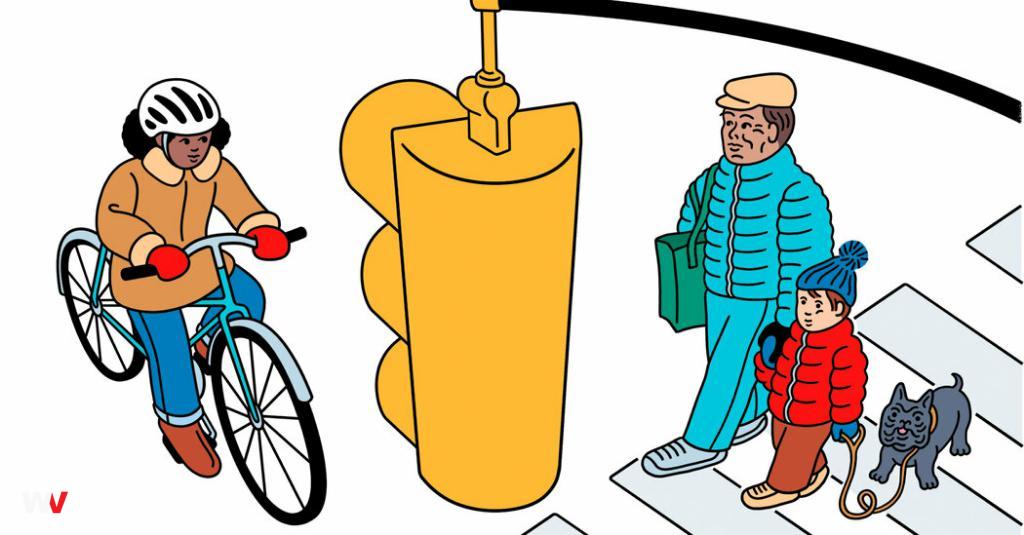
I recently started using my bike as my main mode of transportation, and there are many intersections near my house that feature a pedestrian scramble (a.k.a. an exclusive pedestrian interval). When there are no pedestrians in the walkway but the signal remains on for them, I’m unsure whether I should go. On one hand, it would make my commute more efficient and probably safer (the risk of getting hit by a car is much lower). On the other hand, there’s a vanishingly small chance I hit a pedestrian and a much higher chance I undermine pedestrians’ confidence in their safety — if they see bikes crossing during the designated pedestrian time, they’ll feel less safe in the area in the future. Plus it’s technically illegal. What do you think? — Name Withheld
From the Ethicist:
Those of us who walk in New York City know the unwelcome experience of having bicyclists whizzing through pedestrian crossings when we have the light. Each year, in fact, a few hundred unlucky pedestrians in town will be injured from encounters with bicyclists, a handful fatally. With a pedestrian scramble — also known as a Barnes Dance, in honor of the traffic engineer Henry Barnes — vehicular traffic is paused in both directions; pedestrians can cross the intersection diagonally if they want. If you’ve forded Tokyo’s famous Shibuya Crossing on foot, you’ll be struck (or, rather, not struck) by the ability of hundreds, even thousands of pedestrians to swarm across the intersection without bumping into one another, let alone a car or bike.
I have no doubt that you’d be a careful crosser; your evenhanded summary of the situation suggests that you’re able to look in both directions and size things up. But one rationale for these scrambles is to enhance pedestrian safety by completely separating vehicles from pedestrians. Cyclists who play it by ear, or eye, are defeating the point of the system. And norms get settled by decisions that people like you make. Stay put when your light is red, and you serve as a role model for other cyclists. Predictability and social trust are strengthened when people follow the rules even when they don’t see any benefit in doing so. At a Barnes Dance, it really is best to let the traffic signals lead.
Readers Respond
The previous question was from a reader with a curatorial query. She wrote: “I have a Little Free Library in my front yard. I encourage my neighbors to take books and leave books, and many do. Children’s books are especially popular. … Someone leaves a lot of religious books in my Little Free Library. I welcome Bible stories, prayer books and religious philosophy, but recently donated books are making the case to children against evolution. In storybook form, these books state that the earth is only a few thousand years old, and that dinosaurs and humans coexisted. These are not told as stories, but as the word of God. I realize that parents usually help children choose books from my front yard, and that I do not have an obligation to leave specific books in my L.F.L. indefinitely. Still, these anti-science books present me with an ethical dilemma: If I am opposed to schools’ and public libraries’ banning books like ‘‘In the Night Kitchen,’’ ‘‘Fun Home’’ and ‘‘Heather Has Two Mommies,’’ must I also distribute creationist children’s books?”