
General
Zilia Sánchez, Painter Who Found Fame Late in Life, Dies at 98
A Cuban-born minimalist painter who spent much of her life in Puerto Rico, she was in her 90s when her erotically charged work first appeared at the Venice Biennale.
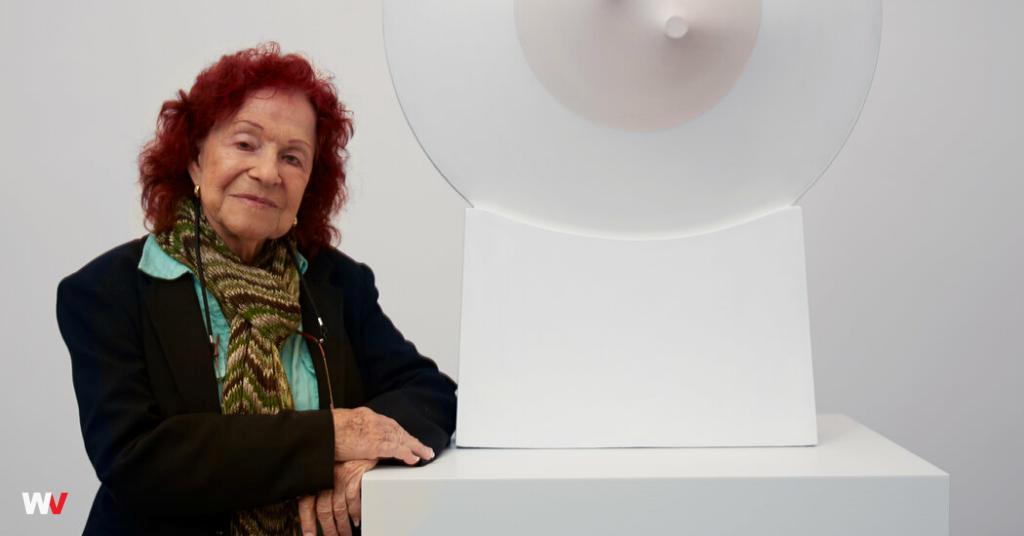
Sometime in the 1950s, Zilia Sánchez, a Cuban-born painter, was crying on a Havana rooftop, mourning the recent death of her father, when she caught a sight that would shape her career of more than seven decades: her father’s bedsheet, drying on a line, draped by the breeze over a nearby pipe and beams.
“I felt like the sheet I had seen blowing in the wind was like his skin, and the wooden construction beneath it resembled a skeleton,” she said in a 2016 interview with Ocula, an art magazine. “I had to eternalize it because of this. It was a very emotional moment and still is an emotional memory. It felt like I saw my father’s soul leaving his body.”
For Ms. Sánchez, who died on Dec. 18 in San Juan, P.R., at 98, the image ultimately inspired her signature creations: minimalist paintings rendered in muted colors applied to canvas skins stretched over elaborate wooden armatures. The results were distinctive three-dimensional works that suggested images of waves, the moon and often the female anatomy, blurring the lines between painting and sculpture.
Still, recognition was a long time coming. Ms. Sánchez was in her 80s when she began to find serious acclaim outside the Caribbean. Her first solo show in New York was a small survey of her work at Artists Space in Lower Manhattan in 2013.
In reviewing that show, the New York Times art critic Holland Cotter wrote: “There is nothing in New York galleries like this work, which has a boldness and strangeness entirely its own. Why we had to wait so long to have a survey is a mystery. Why wasn’t this artist included in the Venice Biennale?” (She eventually was: Her work was shown at the Biennale in 2017 and 2024.)
One reason for the long delay, critics have noted, was that Ms. Sánchez had spent more than a half-century working in Puerto Rico, far from the art centers of Europe and the United States. It was an era when Latina and lesbian artists — she was both — were largely confined to the shadows.