General
My K-Drama Pilgrimage
My parents were both born in North Korea. The Korean War in the 1950s left them and 10 million other Koreans “ee-san gajok,” separated from their families. A move to the United States allowed them to start over and raise four American-born children …
My parents were both born in North Korea. The Korean War in the 1950s left them and 10 million other Koreans “ee-san gajok,” separated from their families. A move to the United States allowed them to start over and raise four American-born children in rural Minnesota.
They always avoided talking about Korea, and I mostly learned about the country on my own, through my research as a novelist, and during a year, decades ago, when I lived in Seoul as a Fulbright scholar.
With my father’s death and my mother’s final slide into dementia, I had an urge to reconnect with the country that’s still a mystery to me. I longed for a tour providing food and sightseeing, but with opportunities to find personal connection on the way.
K-dramas came to my rescue.
During my year in Seoul, I had been teased by the Korean Fulbright staff for my love of yeonsokguk, “serial dramas.” These lugubrious TV shows were usually the purview of at-home elders. I was in my early 30s. But family epics with emotive acting meant I could enjoy them even with minimal language comprehension.
With the advent of streaming, the shows acquired subtitles and burst onto the global scene. In 2019, a week after its premier, “Squid Game” became the most viewed Netflix show in the United States, and would become the company’s most popular series of all time, with 330 million views to date. The second season, airing Dec. 26, has been widely anticipated by fans across the world.
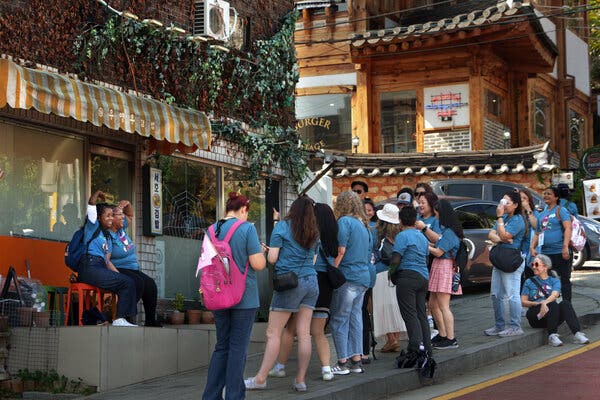
The tour made a short stop in Suwon to view the exterior of the restaurant portrayed in “Extraordinary Woo,” about a kimbap-loving lawyer with autism.Credit…Chang W. Lee/The New York Times