
Fashion
The ‘Monstrous Beauty’ of Pretty Porcelains
A show at the Met offers a feminist revision of Chinoiserie, a decorative style that swept through Europe in the age of empires and seeded stereotypes of Asian women.
The dragon lady, the courtesan, the submissive beauty — these enduring stereotypes of Asian and Southeast Asian femininity circulated in Europe and America centuries before the vast majority of Westerners had ever laid eyes on a real flesh-and-blood woman from those parts of the world.
A major, and maybe surprising, source of these tropes? The Chinese porcelain dishes and figurines that first arrived in Europe by sea in the 16th century, brought by traders who originally used them as ballast for shipments of spices. People went mad for the translucent, lustrous, white material, so unlike the clunky stoneware they were accustomed to. They were equally fascinated by the cobalt-blue decorations that spoke of places, people, gods and other wonders they could only dream of. The wares kicked off a vogue for “Chinoiserie” — a decorative style seen in furniture, textiles and fine art that swept Europe until the 19th century.
An intriguing exhibition at the Metropolitan Museum of Art, “Monstrous Beauty,” brings together more than 200 objects from the 16th century to today, including works by seven contemporary Asian and Asian American women. It is billed as a “feminist revision” of Chinoiserie, asking us to look at these porcelain objects not simply as pretty curiosities but as vehicles for long-held racial and cultural stereotypes about the East, especially when it came to Asian women. All those innocent-seeming pagodas, dragons, bamboo stalks and graceful women, the show argues, had an outsized influence on the West’s image of Asia precisely because they had become so common that people hardly paid attention to them.
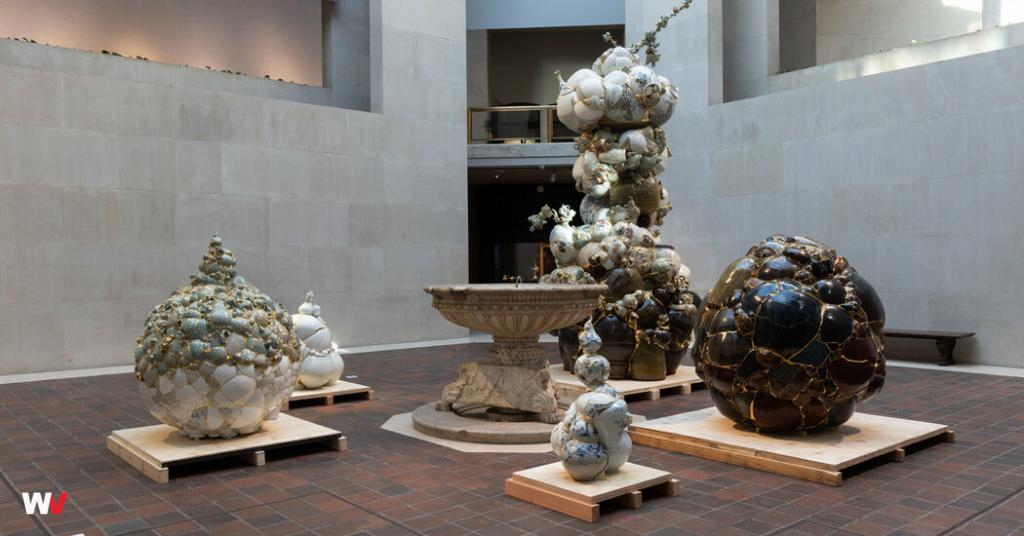
The show opens, spectacularly, with five monumental “translated vases” by the Korean sculptor and painter Yeesookyung. The artist glues together pieces of discarded porcelain and covers the cracks with gold leaf in the manner of Asian practices of repair in which breakage is honored as part of an object’s history. But Yeesookyung’s sculptures don’t simply repair the broken vessels, much less honor them: She transforms them into bulbous, hybrid forms, half weird, half gorgeous and even sublime — monstrous beauties, indeed. An apt opening salvo for an exhibition that aims, as an opening statement suggests, “to shatter the lure of the exotic.”
The earliest objects brought to Europe were made for markets other than Europe, but as the Portuguese, the British and Dutch East India companies and other traders sensed that there was a profit to be made, they began commissioning Chinese manufacturers to cater to Western tastes in both the types of objects they made and their designs. The craze triggered a race to discover porcelain’s closely guarded recipe. (The secret ingredient, the Europeans finally discovered in the mid-18th century, was kaolin, a white clay.)