Fashion
Review: The War Is Never Over in This Epic-Inspired Dance
“Gigenis,” drawn from a tale in the Mahabharata, is the choreographer Akram Khan’s most potent work in years.
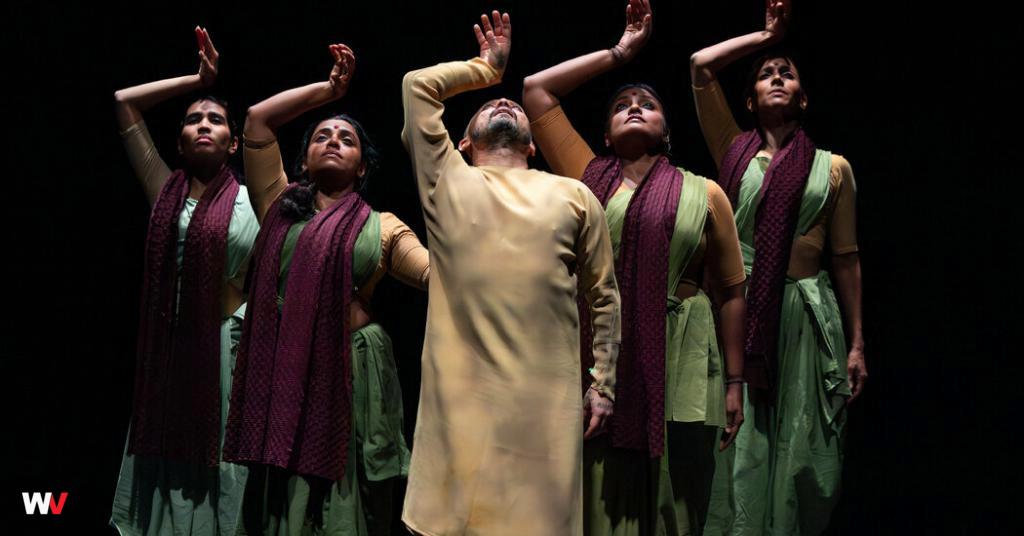
Like many ambitious artists, the British choreographer Akram Khan can confuse impact with magnitude. His opera-house productions often suffer from bloat. Even if he didn’t have personal connections to the Indian epic the Mahabharata — he appeared in Peter Brook’s mammoth production while a teenager — the subject might have tempted him by its sheer size.
Yet “Gigenis: The Generation of the Earth,” his 2024 adaptation of a story line from the Mahabharata, is domestic in scale, fitting nicely onto the stage of the Joyce Theater, where it had its United States premiere on Wednesday. Inspired by the tale of Gandhari, a mother who loses her 100 sons in an epic-size war, the work reduces the son count to a Cain-and-Abel-like pair, illuminating the age-old themes of the seduction of power and the cyclical nature of violence by focusing tightly on the mother and her grief. It is Khan’s most potent effort in years.
It is also a welcome return to his roots in Indian classical dance. Khan, who trained in Kathak as a young man, has gathered expert dancers and musicians in other classical forms, like Bharatanatyam and Odissi. The choreography is collective and hybrid. Khan serves as director and plays one of the sons.
The star is Kapila Venu, who plays the mother figure. The story is told from her perspective, in memory after the worst has happened, as in Martha Graham’s modern-dance treatments of Oedipus and the Oresteia. She silently recalls her youth and courtship, the death of her husband and the murderous rivalry of her sons, as those episodes are enacted by the other six dancers.
Venu is a master of Kutiyattam, an ancient storytelling form that usually involves highly elaborate makeup and costumes. Here she is stripped of those theatrical tools. No matter. In an early, tone-setting solo, she conjures violence as an elemental force — cutting and stabbing invisible enemies, slitting her own throat. Somehow she seems to swell, like the Incredible Hulk. Her eyes bulge, their whites expanding, their pupils shrinking. This is terrifying.