Fashion
Kara Walker: A Fortuneteller in the Land of ChatGPT
The artist’s dystopian installation at SFMOMA shows her evolution as a public artist. In her carnival sideshow she casts a wary eye on tech’s future.
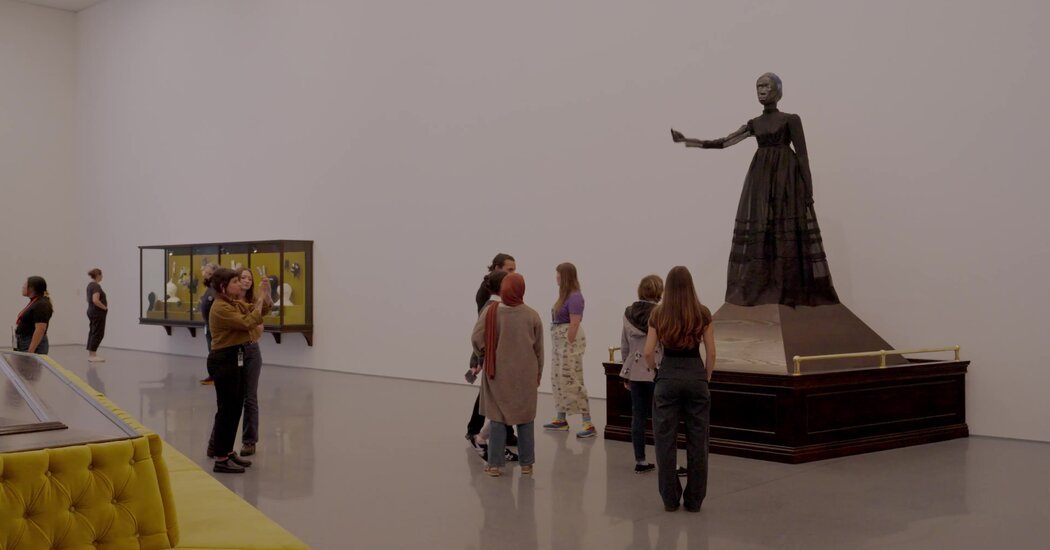
In artworks exploring unequal power dynamics across a wide swath of history, Kara Walker has long called attention to the most inhuman tendencies of people. Now, in a new installation in the country’s tech capital, she is highlighting the superhuman capabilities of A.I. as only she can.
The riveting, kinetic “Fortuna and the Immortality Garden (Machine)” at the San Francisco Museum of Modern Art through spring 2026 presents us with a display of mechanized figures whose movements, powered by technologies new and old, send us back to the future — that is, to the histories of domination and control that underpin all of Walker’s art, and from which advances such as ChatGPT and the iPhone 16 seem unlikely to liberate us.
At the same time, “Fortuna” (for short) — an artwork conceived during the onset of the pandemic, when Walker herself was ill and grieving the loss of her father — offers up the promise of personal and collective healing. Walker’s automatons enact stubbornly human rituals that run the gamut from baptisms to the self-soothing of a child holding a doll, and they do so while standing atop fragments of obsidian (a volcanic glass believed in mystical circles to have trauma-absorbing properties).
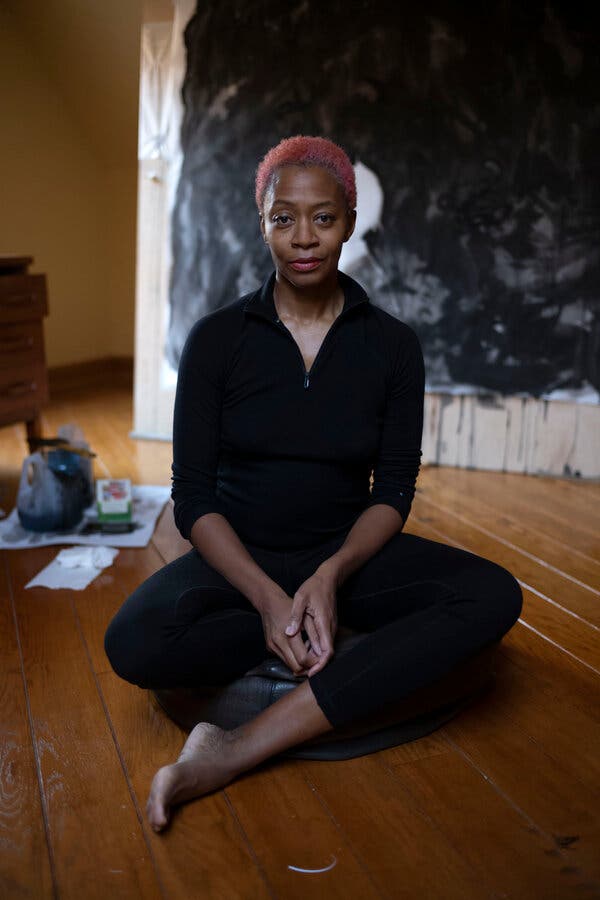
Kara Walker in 2022. Intertwining the digital and the handmade, ‘ “Fortuna” demands much more of us than many other “interactive” installations,” our critic says. Credit…Photo by Ari Marcopoulos, via Sikkema Jenkins & Co. and Sprüth Magers
If these stances feel difficult to reconcile, that’s the point — and it will be a familiar one to admirers of Walker’s big public artworks, starting a decade ago with the majestic sphinx-shaped confection known as “Sugar Baby” and continuing through the large-scale fountain she exhibited in Tate Modern’s Turbine Hall in 2019 as an allegory of the Black Atlantic modeled on London’s Victoria Memorial.
These were works that resurfaced problematic images and antiquated art forms in the hope of generating new ones, and that asked us to sit with conflict and discomfort and see what develops. So is “Fortuna,” which like Walker’s previous installations has an extended, carnivalesque title: “Fortuna and the Immortality Garden (Machine) / A Respite for the Weary Time-Traveler. / Featuring a Rite of Ancient Intelligence Carried out by The Gardeners / Toward the Continued Improvement of the Human Specious / by Kara E-Walker.”