Fashion
Egon Schiele’s Hidden Obsessions Laid Bare
The Austrian Expressionist’s portraits and erotically charged nudes have masked another side of his career: his eccentric landscapes.
Egon Schiele, the widely celebrated Austrian Expressionist, had one of the shortest-ever careers in art. He was only 28 when he died in the flu pandemic of 1918, and his premature death bolstered his image as a symbol of over-the-top Viennese intensity. He is known mainly for drawings of nudes and semi-nudes that can be unnervingly explicit, and he often appears in his own work. With his stand-up hair, skinny body and long, skeletal fingers, he could pass for a contemporary of ours, a proto-punk figure who would seem at home on the Lower East Side.
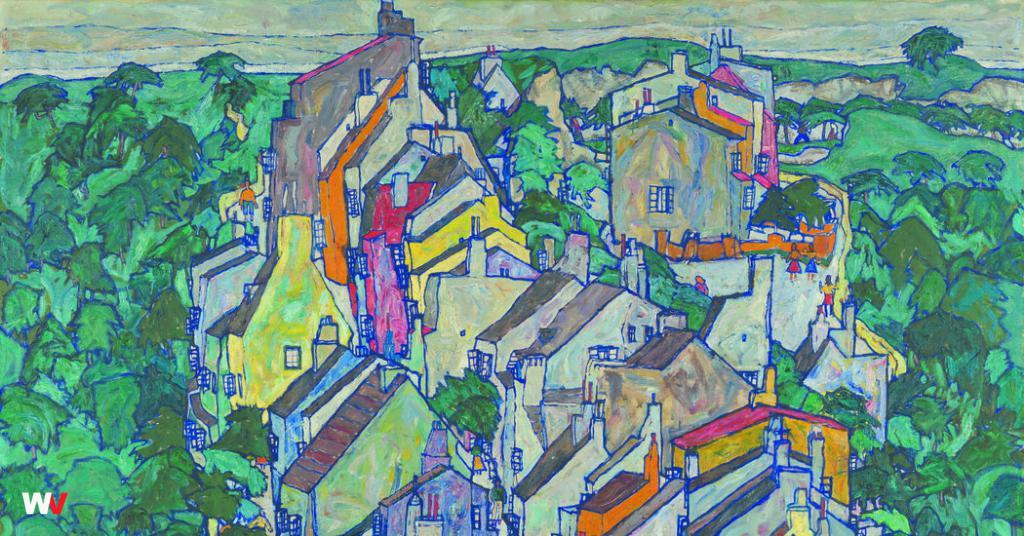
But Schiele never cottoned to city life. His paintings, unlike his drawings, consist largely of landscapes — nature scenes as well as overhead views of empty Austrian villages unperturbed by artists’ models or even the decently clothed. Now, the Neue Galerie has gathered about 60 works spanning his career into the first exhibition of his landscapes.
“Egon Schiele: Living Landscapes” is a stirring, deeply engrossing show that acquaints us with a long-hidden part of the artist’s career. At a time when the Austro-Hungarian empire was in its final years, Schiele turned to landscape as if to reconstitute a disintegrating world. It’s telling that he conceived of his scenes in clearly delineated horizontal bars that give sky, earth and the Danube River an unshakable, marble-like solidity.
Born in June 1890 in countrified Tulln, Austria, Schiele was raised in humble circumstances and had a difficult childhood. He spoke of his mother as aloof and unloving and preferred the company of his “noble father,” who worked as a railroad station master and housed the family in an apartment above the Tulln station. Schiele was 14 when his father died of syphilis, not long after a suicide attempt.
The artist grew up to be rebellious and insecure in equal measure, and was prone to defensive behavior. He attended the prestigious Vienna Academy of Fine Arts but criticized the city, claiming that “everybody is envious of me and deceitful.”
He started painting at 16, and the show at the Neue Galerie opens with some of his earliest efforts. There are competent if conventional scenes of fog-laden meadows and villages silhouetted against distant skies. Most of the scenes feel far away from us, like vistas glimpsed through the dusty windows of a train.