Fashion
A Dinky Little Computer Program Is My Secret Weapon for Creativity
Remember Microsoft Paint? It’s more perfect than ever.
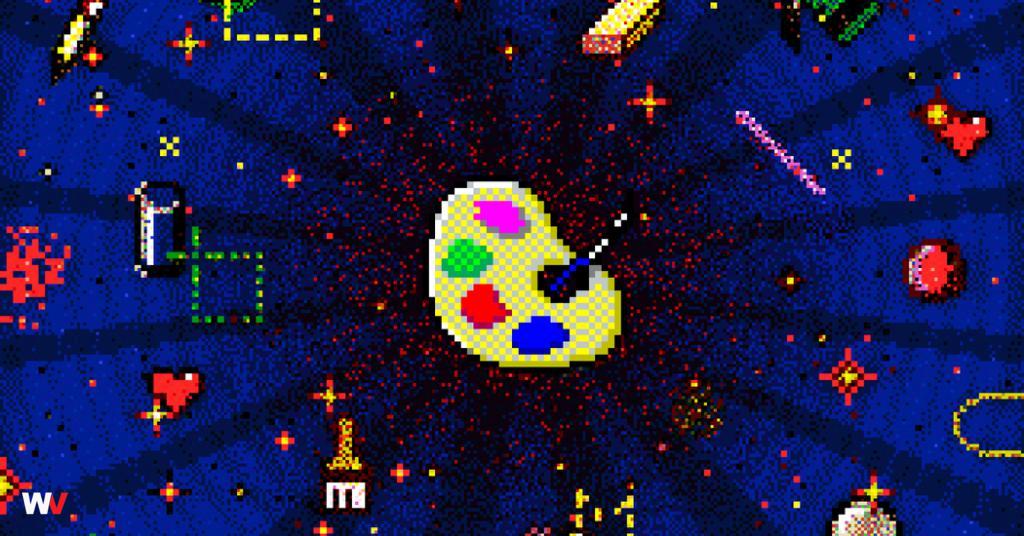
My generation may be the last to have childhood memories of a family “computer room” — though ours was really more of a computer nook: a perpetually dark, narrow corner, packed with tangled wires and plug-in speakers, discarded tchotchkes, dusty dishware and tumbleweeds of dog hair. This was also my sanctuary.
Straining my eyes against the unnatural glow of our boxy PC, I’d throw my heart and soul into what I envisioned as singularly brilliant artwork produced from an underappreciated genius mind. With my hand cramping on the mouse, I’d push my face close to the glass of the monitor so I could devote brain-surgeon levels of concentration. And when I leaned back to wipe the sweat from my brow, expecting to experience Michelangelo’s satisfaction after unearthing David’s finger from the marble, I found instead a hideous mess of crisscrossed black lines forming indecipherable blobs, dotted with jagged explosions of artificial color. Saving the monstrosity as “Untitled.bmp,” I’d close Microsoft Paint and retire for the day, knowing that my work was far from over.
MS Paint dominated my adolescence in the early 2000s. The “art” I ambitiously tried to make on the rudimentary software — a blank canvas equipped with bare-bones tools like pencil, brush, eraser — was sometimes satirical, mimicking my favorite cartoonists Berkeley Breathed or Nicholas Gurewitch; other times it echoed the hostile geographies of J.R.R. Tolkien and Hiromu Arakawa. I had a particular passion for creating imaginary city maps — intricate, brick-and-iron-laden municipalities divided into commercial, industrial and residential zones. After years of admiring beige topographic models of cities and states at highway rest stops, playing board games like Risk and Omaha Beachhead and poring over my brother’s dog-eared atlases, I wanted to become a cartographer of new worlds on Paint.
The results of my struggles — using basic copy-and-pastes of three-pixel-wide buildings to convey urban sprawl, for instance —never turned out how I imagined at the onset. But Paint held sway over me — not because it was secretly great, but because it was so obviously crappy. My creations became admirable because of their extreme effort. Jury-rigging rain clouds out of trapezoids, or hairdos with spray-can bursts, just made the satisfaction sweeter. If you could figure out a way to show it in Paint, you could figure out a way to show it anywhere. If nothing else, you felt the rare satisfaction of genuinely trying.
I recently took a trip to Best Buy, where puzzled employees watched me use a $2,000 top-of-the-line Lenovo desktop to pull up Paint and once again draw these asymmetrical grids and unsightly stick figures. It had been nearly a decade since I last opened the program, after finally relinquishing to pressure to be a functioning adult and use Adobe Photoshop on company-issued MacBooks. I expected to find the software unrecognizable in its sophistication. But to my delight, I was met with the familiar simple tool bar. In five minutes, I used imperfect lines to sketch the outline of a rough cube that quickly became the frame of an even rougher house.
Eventually I became curious about a couple of buttons I didn’t recognize — including one called Image Creator, powered by OpenAI’s text-to-image A.I., which Microsoft claims can “help you unleash your creativity.” I prompted it to generate “a map of a city on a river,” and received back the sort of technically proficient but utterly generic graphic that you might find hanging on the wall of a Days Inn. It unleashed my creativity about as much as buying a Twix bar from a vending machine would make me a pastry chef.