Entertainment
What Makes a Great Search-and-Find Picture Book
Remember Highlights magazine? If you’re as old as I am and ever sat in a children’s dentist’s office in the ’70s or ’80s, you undoubtedly have fond memories of the page known as “Hidden Pictures,” a crude yet captivating drawing of a scene, such as a …

Remember Highlights magazine? If you’re as old as I am and ever sat in a children’s dentist’s office in the ’70s or ’80s, you undoubtedly have fond memories of the page known as “Hidden Pictures,” a crude yet captivating drawing of a scene, such as a beachfront or a school playground, embedded with hidden objects: an anchor, a peanut, a hammer. You would consult the guide, which showed you what you had to find, and then set your little self to work feverishly plowing every square inch of the page. It was all the more fun with a friend, when it became a heated race. And there was no bigger bummer than turning to Page 7 (where “Hidden Pictures” lived) to find that some inconsiderate jerk had already circled them.
In the early 20th century, American newspapers regularly printed these sorts of brainteasers. (“Twenty very pretty summer girls are hidden in the picture,” ran a puzzle in a San Francisco paper in 1913. “How many of them can you find?”) But artists have been playing with these techniques for millenniums. Chinese landscape painters of the Tang and Song dynasties hid tiny man-made structures in their sweeping mountain scenes. And visitors still crowd around the “Unicorn Rests in a Garden” tapestry at the Met Cloisters, trying to spot the frog in the medieval foliage.
Scientists tell us that tasks like solving puzzles or finding hidden images are linked to the brain’s reward system. “Aha” moments when we locate an elusive item release a hit of dopamine, which creates a sensation of pleasure and motivates us to keep going. This may help explain why Highlights has never stopped running “Hidden Pictures,” and why the Where’s Waldo?, I Spy and Can You See What I See? series are still going strong, decades after their debuts.
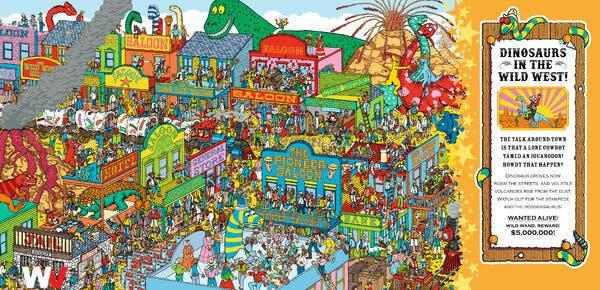
From “Where’s Waldo? The Mighty Magical Mix-Up.”Credit…Martin Handford
Not counting the special editions, spinoffs and activity book versions, WHERE’S WALDO? THE MIGHTY MAGICAL MIX-UP (Candlewick, 32 pp., $18.99, ages 5 to 9) is the eighth book in Martin Handford’s series starring the iconic bespectacled traveler — and the first new one in 15 years. Here, Wizard Whitebeard (a recurring character in the Waldo universe) has lost his magic staff, resulting in a time-space mishap with robots in the Stone Age and dinosaurs in the Wild West. Scanning its pages, I felt a rush of nostalgia recalling the hours my kids and I spent oohing and aahing over Waldo when they were little. I can’t say this one is as eye-popping as the old ones (I’m partial to “Where’s Waldo? In Hollywood”), but it delivers the goods nonetheless, displaying Handford’s knack for layering his cacophonous crowd scenes with humor.
My kids and I weren’t big fans of the popular I Spyseries by the photographer Walter Wick, which debuted in 1992. This was probably because Wick’s still-life assemblages lacked the whimsy of Waldo, and (to my mind) had a less intriguing visual style. So I was pleasantly surprised to find myself sucked into THE CURIOSITY SHOP (Cartwheel Books/Scholastic, 40 pp., $18.99, ages 4 to 8), the 11th book in his Can You See What I See?series, launched in 2002, which has more of a narrative, cinematic quality than I Spy. This book is set in a mysterious shop stocked floor to ceiling with things like vintage maps, marionettes, colored glass and antique toys, which readers are directed by the book’s rhymes to identify (“3 safety pins,/2 electric guitars,/an ON/OFF switch,/a bus, 8 cars”). Each scene cleverly leads to the next — zooming in, pulling back or rounding a corner like a virtual real estate tour. It’s stunning and atmospheric.