Entertainment
What Does Utopia Look Like for Black Americans?
Aaron Robertson’s grandparents had a farm in Promise Land, Tenn. In a new book, he explores the history and meaning of such utopian communities for African Americans.
THE BLACK UTOPIANS: Searching for Paradise and the Promised Land in America, by Aaron Robertson
Looked at from a certain surface-level perspective, the whole notion of Black utopianism can seem to entail a paradox. As the literary scholar Charles Scruggs put it more than 30 years ago in “Sweet Home: Invisible Cities in the Afro-American Novel,” “Given what we know about the position of Black Americans within a racist society, the idea of a Black utopian city may seem absurd on the face of it.”
Yet the opposite observation seems equally true. Those with the least to lose, socially and economically speaking, are often the most receptive to radical thinking on how to reorder human society, and the most fluent in wielding it, at least in the imaginative realm. To quote Aaron Robertson, in his interesting and idiosyncratic new book, “The Black Utopians,” “The apparent persistence of abysmal realities for Black people, and the certainty that there exists much more besides, is the soil from which Black utopianism emerges.”
This book is a formal hybrid that oscillates between a personal history and a more scholarly one. Plenty of pages perform, in a relatively straightforward way, the work one might come to the book expecting — that is, they discuss “the diverse dreams, migrations and collective social experiments of African Americans.” Other chapters are more impressionistic. Several consist of letters written to the author by his father, which describe the elder man’s hardships (among them a decade-long prison stint for armed robbery) and his fascination with a Kentucky preacher named Stephen Darby, who sermonized online about an 18th-century Black utopia known as Negroland.
Some readers may find this eccentric structure bemusing, but Robertson comes by it honestly. He grew up in Detroit (of all American cities, perhaps the one most often called a “dystopia,” he notes with irony), but his youth was marked by memorable “pilgrimages” to his grandparents’ farm in a place called Promise Land, about 40 miles west of Nashville. Founded soon after the Civil War by newly freed African American families who had been enslaved at a nearby ironworks, the settlement — which exists today, though barely — fits into a tradition of Reconstruction-era Black townships born in a frontier-utopian spirit. The slavocracy was dead. New ways of living and being briefly seemed possible in the ruins. Robertson was fascinated by the traces of these energies, as preserved in his grandparents’ memories. He beautifully reconstructs the history of their town, as it ran through the lives of his ancestors:
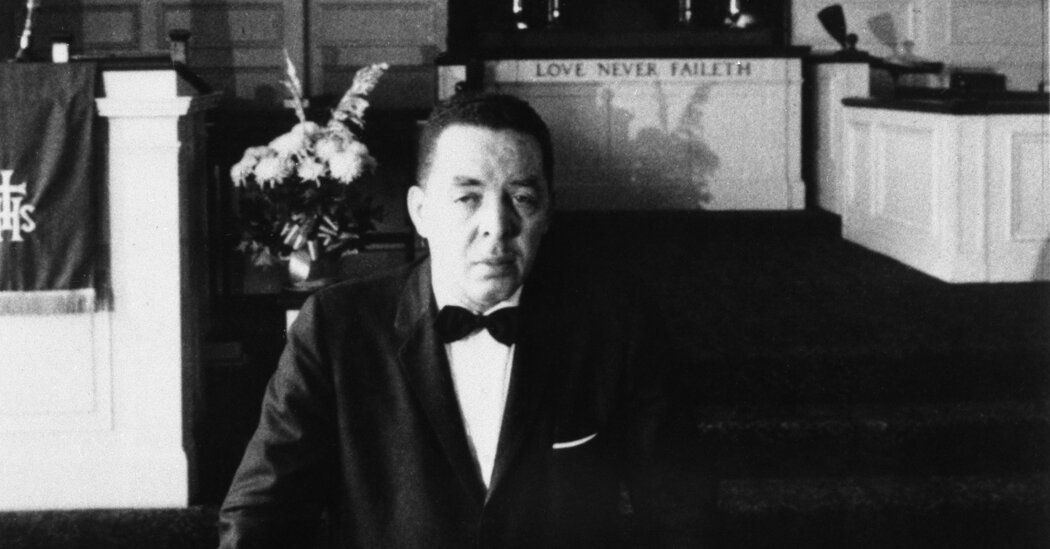
Those Southern experiences sensitized Robertson to a utopia closer to home, namely, Black Christian Nationalism, a major urban social-reform movement established in Detroit by the Rev. Albert B. Cleage Jr. The Black Christian Nationalists, in turn, bought a 4,000-acre farm down in South Carolina, and called it Beulah Land. They dreamed of working it collectively and exporting the fresh produce to inner-city neighborhoods across America.
The book thus shuttles back and forth from North to South, like its author, imparting a sort of regional warp and woof to the narrative. One of the letters from his father shows that Robertson inherited this pattern or had it in his bones. “Being happy in Tennessee,” his father writes, “made me realize that I hated Detroit. Whenever we left to return north, I would enter my first stage of depression. The depression would deepen in Kentucky. By the time we were in Toledo, Ohio, I was bracing for the disappointments of my daily life.”