Entertainment
The Needy Genius Who Understood the Cosmos (People, Not So Much)
“The Impossible Man,” by Patchen Barss, depicts the British mathematical physicist and Nobelist Sir Roger Penrose in all his iconoclastic complexity.
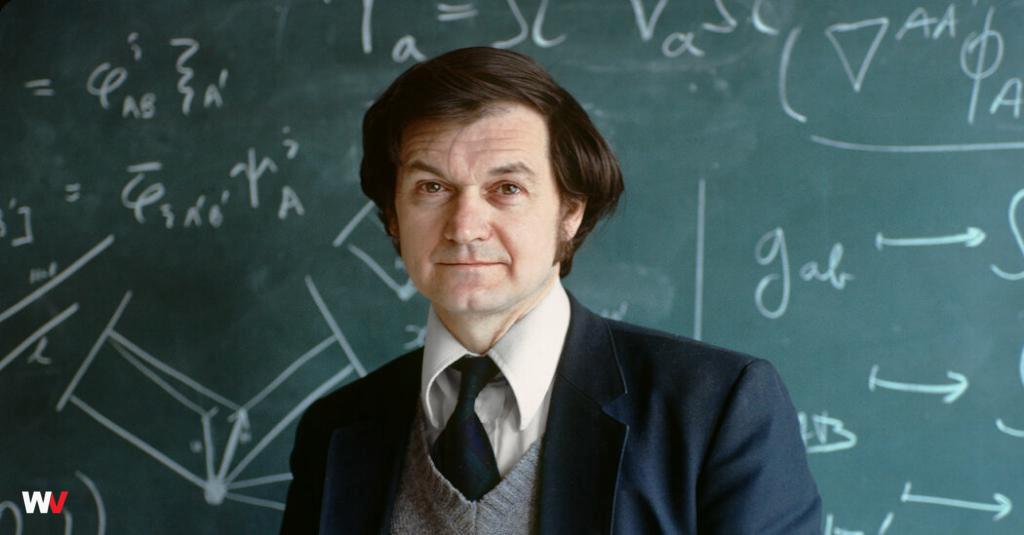
THE IMPOSSIBLE MAN: Roger Penrose and the Cost of Genius, by Patchen Barss
The Science Museum in Britain holds numerous items associated with the Nobel Prize-winning mathematical physicist Sir Roger Penrose: books on consciousness and the nature of space and time; a set of wooden puzzles made by his physician father; a model of one of the Penroses’ “impossible objects” — a staircase on which a person could ascend or descend forever.
But maybe the most extraordinary item is also the most ordinary: a four-pack of Kleenex Quilted Peach Toilet Tissue. The quilting was based on one of Penrose’s non-repeating tiling patterns in order to avoid “nesting,” which would have risked stuck squares and unsightly bulges in the roll — yet nobody from Kleenex had consulted Penrose. In 1997, Pentaplex, a company set up to develop commercial applications of his work, sued the toilet paper’s manufacturer, Kimberly Clark. As a Pentaplex director announced at the time: “When it comes to the population of Great Britain being invited to wipe their bottoms on what appears to be the work of a knight of the realm without his permission, then a last stand must be made.”
After the case was settled out of court, “Penrose tiles never again surprised anyone entering the loo,” writes Patchen Barss in “The Impossible Man,” his new biography of Sir Roger. Barss spent lots of in-person time with Penrose, 93, and spoke to him by video chat or phone almost every week for five years. While the toilet paper episode had a happy ending, many of the others in this book do not. “He was consistently willing to respond to my questions,” writes Barss in an author’s note, “even when the answers were difficult or painful.”
The result is a moving and intimate portrait of a figure who has expanded our understanding of the universe — and offered a controversial alternative to the Big Bang theory about its origins — yet has struggled to connect with his fellow human beings. Barss embeds the work in the life, taking any chance he can get to link abstract theoretical concepts with things we can see and touch in the visible world. On the very first page he offers a cozy scene of Penrose adding a splash of milk to his cup of coffee, “the cold globules of lactose, protein and fat” eventually dissipating into the hotter liquid — a vivid image for how “the universe moves relentlessly toward greater entropy” until “even the last surviving black holes will ultimately boil away into an oblivion of scattered radiation.”
Much of the writing in “The Impossible Man” is similarly evocative. Barss, a science journalist based in Toronto, is ever attuned to how sentences and storytelling, like mathematical equations and Penrose’s own line drawings, can bring us closer to the “world-behind-the-world.” Penrose himself has long been known for his visual sensibility. He recalls an early introduction to the powers of geometry when, as a picky 6-year-old, he pushed a blob of stewed greens on his lunch plate into a semicircle — thereby tricking his nanny into believing he had eaten half his spinach and freeing him to go play outside.