Entertainment
How the Dream of School Integration Died
A powerful new book by the law professor Michelle Adams recounts the failed effort to integrate Detroit’s schools and the case’s relevance today.
THE CONTAINMENT: Detroit, the Supreme Court, and the Battle for Racial Justice in the North, by Michelle Adams
Michigan prohibited segregation in public education decades before the Supreme Court did the same for the nation in Brown v. Board of Education in 1954. Yet nearly 20 years after Brown, the public schools in Detroit remained almost totally segregated. The story of how that happened, the failed effort to change it, and the implications for public education and civil rights today is the subject of Michelle Adams’s splendid new book, “The Containment.”
The Detroit schools were segregated not because a law required it, but because the city, like virtually everywhere in the United States, operated on a neighborhood school model. And since Detroit’s neighborhoods were highly segregated — 99 percent white in some areas and 95 percent Black in others in 1970 — its schools were, too. Why? Because, Adams writes, of a longstanding policy of containment: a system of government and private actions that kept the city’s Black citizens confined to a handful of neighborhoods in Detroit and out of the suburbs altogether. The tools of the containment included racially restrictive covenants in housing deeds (no sales to Black people allowed), redlining (mortgages for Black home buyers only in certain areas), as well as segregated public housing and segregated real estate salesperson associations.
“The Containment” follows the lawsuit, filed in 1970 by the N.A.A.C.P., to integrate Detroit’s schools. In this objective, the civil rights group eventually found an unlikely but revealing ally: the Citizens Committee for Better Education, which represented the already shrinking white population of the northern part of the city, an area bordered, as all Eminem fans know, by the road known as Eight Mile.
The C.C.B.E. originally entered the case as an opponent of the N.A.A.C.P. In time, however, the C.C.B.E. became a partner of sorts, because its members — mostly working-class white families — began arguing to the federal judge Stephen J. Roth that it was unfair to place the burden of integration exclusively on the whites of Detroit, who could not afford to move north of Eight Mile, while shielding their wealthier white neighbors in the suburbs. Roth, a conservative Democrat and former state attorney general, ultimately saw the logic of the argument. In this way, Adams’s book explores class as well as race, with a richness and sophistication that recall J. Anthony Lukas’s 1985 masterpiece, “Common Ground,” which told the story of the struggle over the desegregation of Boston’s public schools at around the same time.
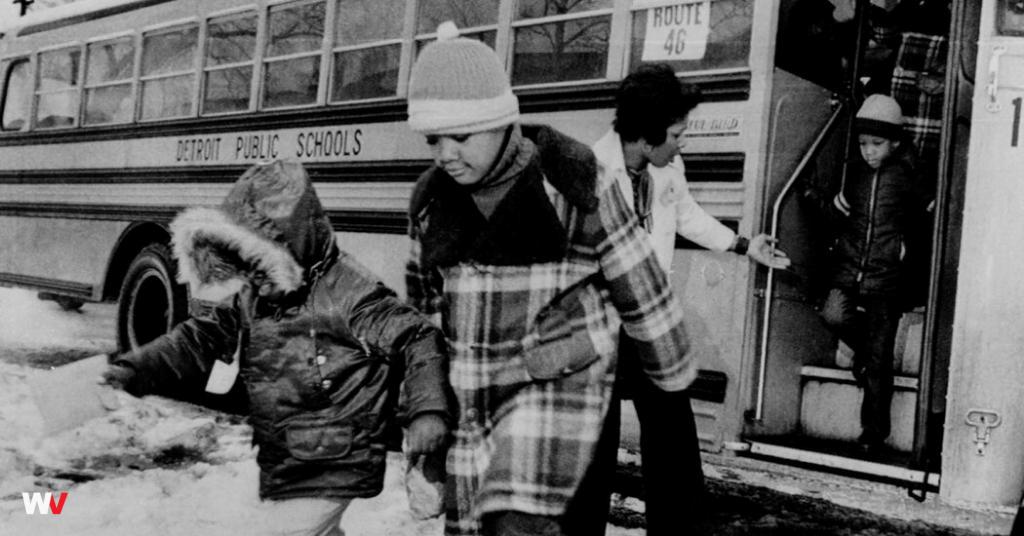
In June 1972, Judge Roth ordered a broad integration plan, which included such prosperous suburbs as Grosse Pointe and Bloomfield Hills in the same “metropolitan” school district as Detroit. That is, he established a system of “busing” — a word that was every bit as politically incendiary at that time as “trans” is today. The suburbs recoiled in horror, and politicians joined in.