Entertainment
Harold Makes the World With His Purple Crayon. Who Made Harold?
Before there was a feature film or a book, there was Crockett Johnson.
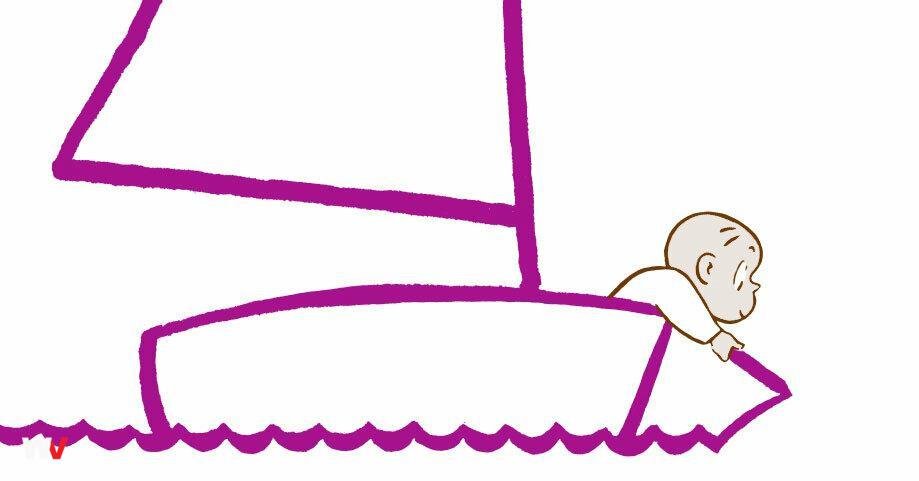
“How does Harold draw himself?” my friend Noam wondered. Noam is 4, so he has a taste for the kind of bracing philosophical speculation that “Harold and the Purple Crayon” — the classic children’s book about a young boy and his magical marker — invites, along with wonder, mischief and delight.
There are grown-ups who might answer that Harold obviously doesn’t draw himself, since he’s the only figure in the book not rendered in a thick purple line. But Noam has a point. Harold is the sole visible creator in his universe. The pages he inhabits are plain white expanses until he fills them: with simple objects like a half-moon, a window frame and a sailboat; with more elaborate compositions like a high-rise cityscape, an apple tree guarded by a dragon and a seaside picnic featuring a moose, a porcupine and nine kinds of pie.
Given such effortless, abundant inventiveness, it’s reasonable to surmise that this industrious and unflappable child might indeed be his own creation. At least in “Purple Crayon,” the first of seven books about Harold, there is no sign of a parent, though Harold does have a home and a bed. (A mother is mentioned in his second adventure, “Harold’s Fairy Tale.”) Even things that might have already been there seem to flow from his crayon, which underlines the paradox that captivated Noam. Harold makes his world. Who made Harold?
While I’ve always been charmed, and sometimes unnerved, by the deep metaphysics of children’s literature, I’m more comfortable dealing with empirical, historical matters. So for the moment I’ll dodge my friend’s query. Harold is the brainchild of Crockett Johnson, who was born in 1906 and took up picture books in midlife, after a career as a design director and political cartoonist. But Johnson himself was to some degree self-invented. The name on his birth certificate is David Leisk; the name on the books was not so much a pseudonym (Johnson was his middle name, Crockett a childhood nickname) as a persona, just as “Seuss” (also a middle name) was for his contemporary Theodor Geisel.
Their careers followed similar paths. Like Geisel, Leisk spent much of the 1930s and early ’40s working in advertising and lending his graphic talents to antifascist and left-wing causes. Unlike Geisel, he drew a syndicated daily comic strip, “Barnaby,” which ran from 1942 to 1947. The titular character is a sensible, self-sufficient 5-year-old with an active imagination and an exasperating imaginary friend (or “fairy godfather”) called Mr. O’Malley. A forerunner of both Charles Schulz’s “Peanuts” (for its unsentimental child’s-eye view of the world) and Walt Kelly’s “Pogo” (for its satirical pokes at contemporary reality), “Barnaby” counted Dorothy Parker, Duke Ellington and W.C. Fields among its fans.