Magazine
At the Biggest Fish Market in the U.S., 3 A.M. Is Prime Time
The 212 column revisits New York institutions that have helped define the city, from time-honored restaurants to unsung dives. At two in the morning, when most of the South Bronx is dark and quiet, enormous trucks lumber along the Bruckner Expressway …

The 212 column revisits New York institutions that have helped define the city, from time-honored restaurants to unsung dives.
At two in the morning, when most of the South Bronx is dark and quiet, enormous trucks lumber along the Bruckner Expressway toward Hunts Point, the little East River peninsula almost directly opposite Rikers Island. Wholesale warehouses here supply many of the city’s comestibles and among them, at 800 Food Center Drive, is the Fulton Fish Market.
The original incarnation of the market, which is now 202 years old, was 13 miles away in Lower Manhattan, near the Brooklyn Bridge. It opened in 1822 and remained there until 2005, when it outgrew its longtime home and moved up to the Bronx.
“Breakfast?” says Joe Gurrera as soon as I arrive. He’s standing at one of his stalls in the middle of the market and grinning as he slices a morsel off a 90-pound tuna. Gurrera, the 70-year-old owner of Citarella, a group of seven upscale grocery stores in New York and Connecticut that specialize in seafood, has worked at the Fulton Fish Market, which functions as a cooperative, most of his life. He was a teenager when he learned his way around the old market, helping his father, who had a fish store in Greenwich Village.
It’s cold in the market, which is essentially a 400,000-square-foot shed. Underfoot, the floors are wet with melting ice. Gurrera is one of 22 shareholders in the market, and his company Lockwood & Winant occupies about 11 percent of the space. He sources seafood for his Citarella shops and also sells to other fishmongers. Well before dawn, the market is alive with buyers and sellers meeting, greeting, bargaining. “Many of the shareholders have been around for four to six generations,” says Nicole Ackerina, 37, the C.E.O. of the market.

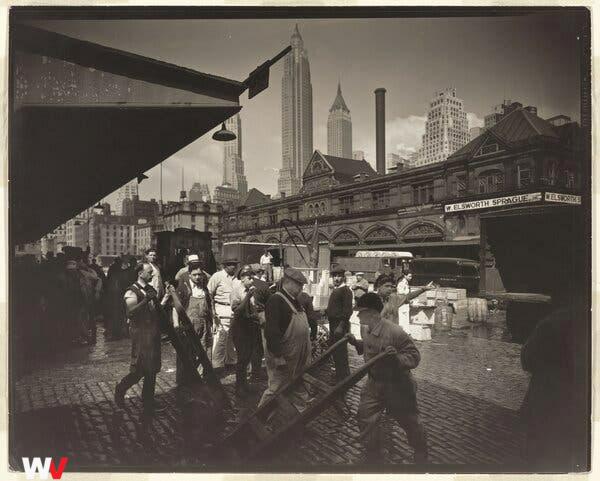
Workers at the market in 1936, when it was still located in Lower Manhattan.Credit…Berenice Abbott/New York Public Library Digital Collections