
General
Let’s Not Bring Back Jail for Swearing
With its new term starting this month, the Supreme Court will likely confront calls to upend constitutional law yet again. One very possible target is people’s everyday right to voice their political opinions, to speak up, even just to swear …
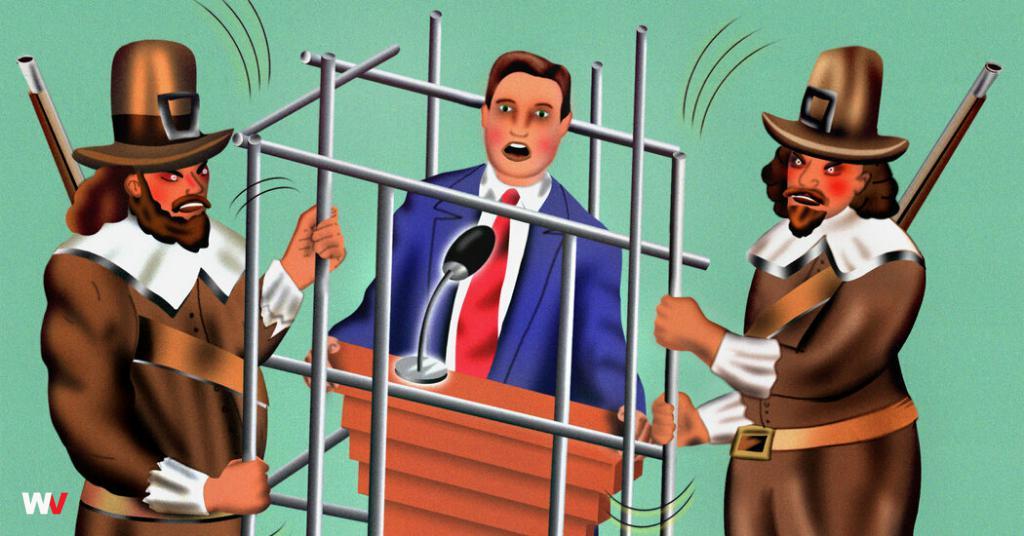
With its new term starting this month, the Supreme Court will likely confront calls to upend constitutional law yet again. One very possible target is people’s everyday right to voice their political opinions, to speak up, even just to swear.
Consider what happened last month when a federal court of appeals decided a First Amendment challenge by JD Vance and others. The challenge invoked a less literal kind of speech, seeking to allow political parties to coordinate spending with party candidates. As expected, the challenge was rejected. But five judges argued that the case might come out differently if only the Supreme Court would start treating First Amendment cases the way it has recently begun treating Second Amendment cases. Specifically, Judge John Bush said that judges should discern the original understanding of free speech in “linguistical meaning” and “evidence of how Americans ordered their lives” in the 1790s.
If that sounds like a bizarre standard for which views you should and should not be allowed to express, that’s because it is. During the founding era, the right to free speech was understood much more narrowly than it is today. Something as simple as swearing or voicing unpopular political opinions might land you on the wrong side of the law. If rules from the 1790s were enforced today, citizens could be jailed for criticizing politicians, public figures could freely use defamation law to punish critics and schoolchildren would have few if any free speech rights.
But these judges are not alone. Recently, Judge Kevin Newsom of the Court of Appeals for the 11th Circuit said it would be “terrific” if courts started asking “what ‘the freedom of speech’ meant to the founders.” In NetChoice LLC v. Paxton, the case challenging Texas’ social media law that made it to the Supreme Court last term, the Court of Appeals for the Fifth Circuit even criticized the challengers of the law for relying on legal precedent rather than the “original public meaning” of the First Amendment.
Using history alone to define First Amendment freedoms is a very bad idea. This approach is sowing chaos in gun rights cases around the country. It has proved unworkable, unpredictable and easily manipulable by judges seeking to reach a preferred result — a cautionary tale, not something to be emulated elsewhere.
As you may recall, this most recent turn toward history started with New York State Rifle & Pistol Association, Inc. v. Bruen. In that ruling, Justice Clarence Thomas and five of his colleagues held that gun regulations are only constitutional if the government can prove that they are “part of the historical tradition that delimits the outer bounds of the right to keep and bear arms.” The court promised that this history-centric approach was “more legitimate, and more administrable” than asking judges to make difficult empirical judgments about a field in which they are not experts.