General
In Puerto Rico, a Struggle for Power Comes to Light
The Trump administration is clawing back millions in climate grants promised to credit unions in Puerto Rico. A reporter traveled to the island to meet people affected by the rollback.

Times Insider explains who we are and what we do and delivers behind-the-scenes insights into how our journalism comes together.
I met Elsa Modesto at her home in the southern coastal town of Salinas, Puerto Rico, less than a month after a blackout in April had plunged much of the island into darkness. But she had barely noticed the outage.
Ms. Modesto’s home was equipped with a solar system, complete with rooftop panels hooked up to a large wall-mounted battery that peeked out from behind her washing machine. As the lights flickered out in houses across the neighborhood, hers stayed on. And her fridge never stopped humming. That was a relief: Ms. Modesto, a diabetic, used to worry about her insulin supplies during power outages. She would sometimes submerge the medicine in cold water to prevent it from spoiling.
I was in Puerto Rico to report on the effects of the Environmental Protection Agency’s attempts to claw back some $20 billion in climate grants. Of that, more than $100 million had been promised to credit unions in Puerto Rico. The credit unions planned to use the grants to offer people low-cost loans for rooftop solar installations.
As of this month, the money still hasn’t arrived. (Ms. Modesto received her system through a local pilot project.)
This winter, in my first Climate Forward newsletter, I wrote about the controversy that ignited after the head of the E.P.A., Lee Zeldin, called for the return of the funds to the federal government; the subsequent funding freeze prompted several of the nonprofit grant recipients to sue. The E.P.A. later moved to cancel the grants outright.
I had followed the ensuing court battle closely for months. With an appellate hearing pending, I wanted to understand how the funding freeze was affecting the communities that had been promised support.
That brought me to Puerto Rico, where the need for rooftop solar installations has taken on particular urgency. There a resident on average loses power eight times per year. Two large-scale blackouts have also swept the island in the last six months. Solar energy provides a critical backup source when the power grids fail.
I spent two days last month crisscrossing the island, at one point driving down a road so narrow that branches brushed both sides of my rental car. I wanted to talk to people who would jump at the chance to buy solar systems if federal support made them affordable.
In the mountains of La Ruta del Lechón, I met a bakery owner who a few years ago had taken out a loan for a set of panels and has monitored battery prices ever since, hoping to add storage to his system. Lower interest rates made possible by the federal grants could have helped the numbers pencil out. But at current rates, he said, he has to wait until his panels are fully paid off. For now, his power goes out whenever the grid fails.



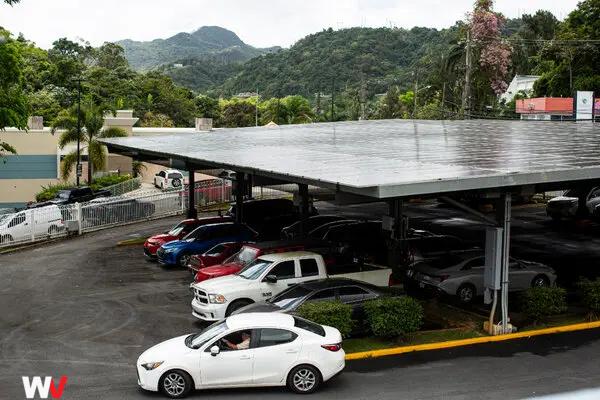
A parking lot outside the headquarters of Credicentro-Coop, a solar lender in Puerto Rico.Credit…Erika P. Rodriguez for The New York Times
I also drove south to Salinas, where I met Wanda Ríos Colorado at her local credit union. There she was inquiring about loan options for her multistep plan to bring solar power to her entire 314-home neighborhood. The plan involves solar systems for individual homes and a microgrid that would power several houses at a time.
I was impressed that much of the plan seemed ready for construction. Then she told me about the millions of dollars in federal funding that had been promised for the project but had not yet materialized. More than 50 people in her community sit on a waiting list for solar power, and she worries older residents could trip and fall during outages.
As I walked around her neighborhood, and imagined it producing its own electricity, I couldn’t forget the circumstances that made these plans feel so pressing. The community sits alongside the beach and a river, and gets hit with intense summer storms. A period of heavy rainfall can bring a one-two punch: first, the rains pummel the town. Then, the river overruns its banks, inundating local homes.
Solar power can’t prevent flooding, but it can help residents deal with the fallout. Ms. Ríos Colorado showed me a picture of her couch with a puddle of water creeping up the legs. She joked that the image was clear because the lights had stayed on.
After interviewing several people, I was struck that so many saw solar power as just another energy source. They didn’t seem to care so much that it was better for the environment — they just wanted the lights to stay on.
The E.P.A. grant funds remain frozen as an appeals court considers the case. But Ms. Ríos Colorado remains hopeful. During our last conversation, she said her goal was to get solar systems installed in dozens of homes before peak hurricane season in September.
It would be a challenging timeline, even if funding was available today.