General
Friday Briefing
Fighting escalates in Gaza.


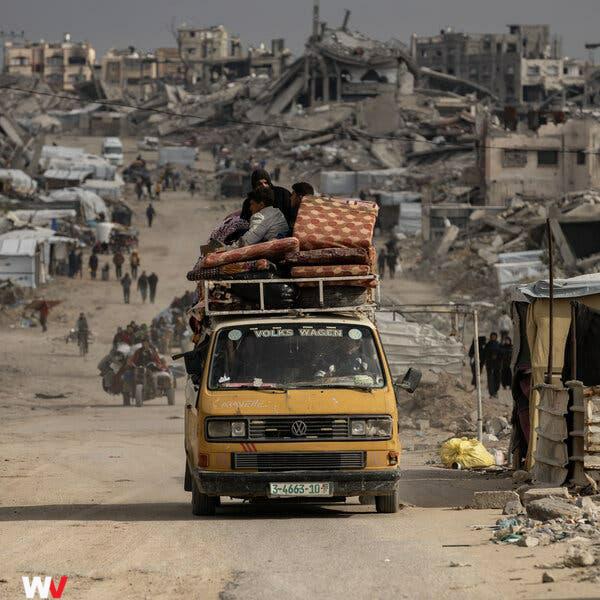
Palestinians fled northern Gaza after the Israeli military issued warnings to evacuate homes.Credit…Saher Alghorra for The New York Times
Hamas fired rockets at Tel Aviv
Hamas fired its first barrage of rockets in months into Israeli territory yesterday as Israeli troops expanded ground operations across Gaza, including a raid on part of Rafah in southern Gaza, the military said, as well as actions near Beit Lahiya in the north. After the collapse of a two-month cease-fire, the fighting now looks as if it is escalating back to full-scale war.
Despite street protests in Israel, the Israeli government around midnight yesterday approved Prime Minister Benjamin Netanyahu’s ouster of the head of the Shin Bet domestic intelligence agency.
Patrick Kingsley, our Jerusalem bureau chief, shared more insight on the situation.
Patrick: We are back in a familiar standoff. Israel’s leadership wants both the safe return of Hamas’s hostages, as well as Hamas’s military defeat. But Hamas won’t hand over the hostages without Israel’s guaranteeing the group’s survival in Gaza. And Israel can’t defeat Hamas by force without harming many hostages. The cease-fire that collapsed this week was always likely to fall apart unless one of the sides softened its stance. But neither did. So Israel has returned to war in order to break Hamas’s resolve by force. That leaves things roughly where they were before the cease-fire: in a deadlock.
Do the protests in Israel feel more impactful this time?
For now, Netanyahu doesn’t seem swayed by the protesters calling for a new truce to save the hostages. His biggest domestic priority is to pass a state budget by the end of the month. To do that, he needs the support of right-wing lawmakers, many of whom support the return to war and could abandon him if there’s another truce.
Is President Trump’s Gaza plan still on the table?
After proposing the expulsion of Gaza’s population in January, Trump has said that the idea was only a recommendation and that no Palestinians would be expelled. His aides also said that it was less a definitive plan of action than an attempt to provoke Arab leaders into suggesting a viable alternative.
Several Arab leaders, led by Egypt, did later propose their own plan for postwar Gaza — in which the territory would be governed by an apolitical committee as part of a Palestinian state. But the plan was vague, didn’t explain how Hamas would cede power and was swiftly rejected by the Israeli government, which seeks to avoid discussion of Palestinian statehood.