General
A $300 Million Art Trove and the Labyrinth of Nazi-Era Art Claims
Claims on the Guelph Treasure stretch back nearly two decades, and Germany’s plans to change how restitutions are evaluated are now adding new wrinkles.
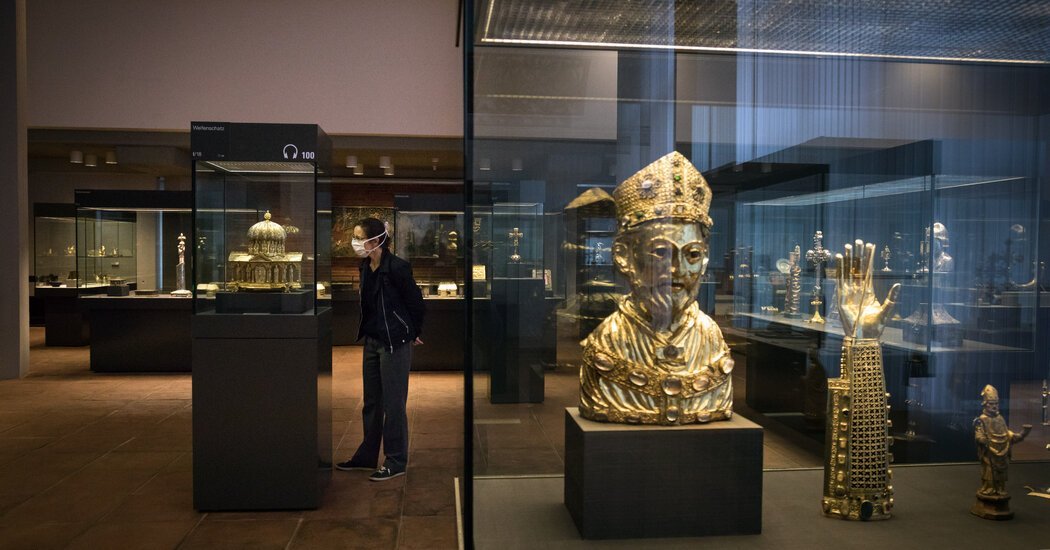
A new chapter has opened in a bitter 17-year battle for the Guelph Treasure, one of the most valuable art troves claimed by the heirs of Jewish victims of Nazi rule, after the discovery of documents in a German archive indicating that its sale in 1935 was made under duress.
The trove, estimated to be worth $300 million, consists of gem-encrusted medieval ecclesiastical artifacts, primarily reliquaries and crosses. The most valuable of these is a 12th-century reliquary shaped like a church and made of gold, silver and copper; it is adorned with figurines of biblical characters carved out of walrus tusk.
The dispute dates back to 2008, when the heirs of four art dealers who were members of a consortium of Jewish owners of the Guelph Treasure filed a claim with the current holder, the Prussian Cultural Heritage Foundation in Berlin. Since then, the case has grown ever more complicated, in part because the composition of the consortium cannot be fully reconstructed, despite much research.
And now, there is a new claim, by the heir of a consortium member, Alice Koch, whose interests had not been considered before. The claim comes as Germany considers a major change in settling restitution disputes. The government has announced it will dismantle its advisory commission on Nazi-looted art and replace it with a binding arbitration tribunal, but the timing of this switch is not yet clear.
Today, the Guelph pieces are prize exhibits at the Museum of Applied Art in Berlin, which is overseen by the Prussian Cultural Heritage Foundation. Earlier this month the foundation agreed to hold a new hearing with the German government’s advisory commission on Nazi-looted art because of the fresh evidence that the documents revealed.
Lawyers representing the Koch heir, whose great-grandmother owned 25 percent of the Guelph Treasure, discovered the German archival documents, which show that Koch was forced to pay the punitive “Reich flight tax” in October 1935 before fleeing to Switzerland. She used her proceeds from the sale of the Guelph Treasure, which took place four months earlier, to pay the Nazi regime’s bill for 1.2 million Reichsmarks, said Jörg Rosbach, the Berlin lawyer representing one of Koch’s heirs. The sum is equivalent to millions of dollars today.